PosterCutter Blog
National First Responders Day: 9 Classroom Activities That Go Beyond a Thank-You Coloring Page
National First Responders Day is October 28. Use the occasion for meaningful reading, vocabulary, community-helper research, emergency-preparedness thinking, thank-you writing, and a collaborative class display — with practical ideas for grades K–5 and teacher-sellers.
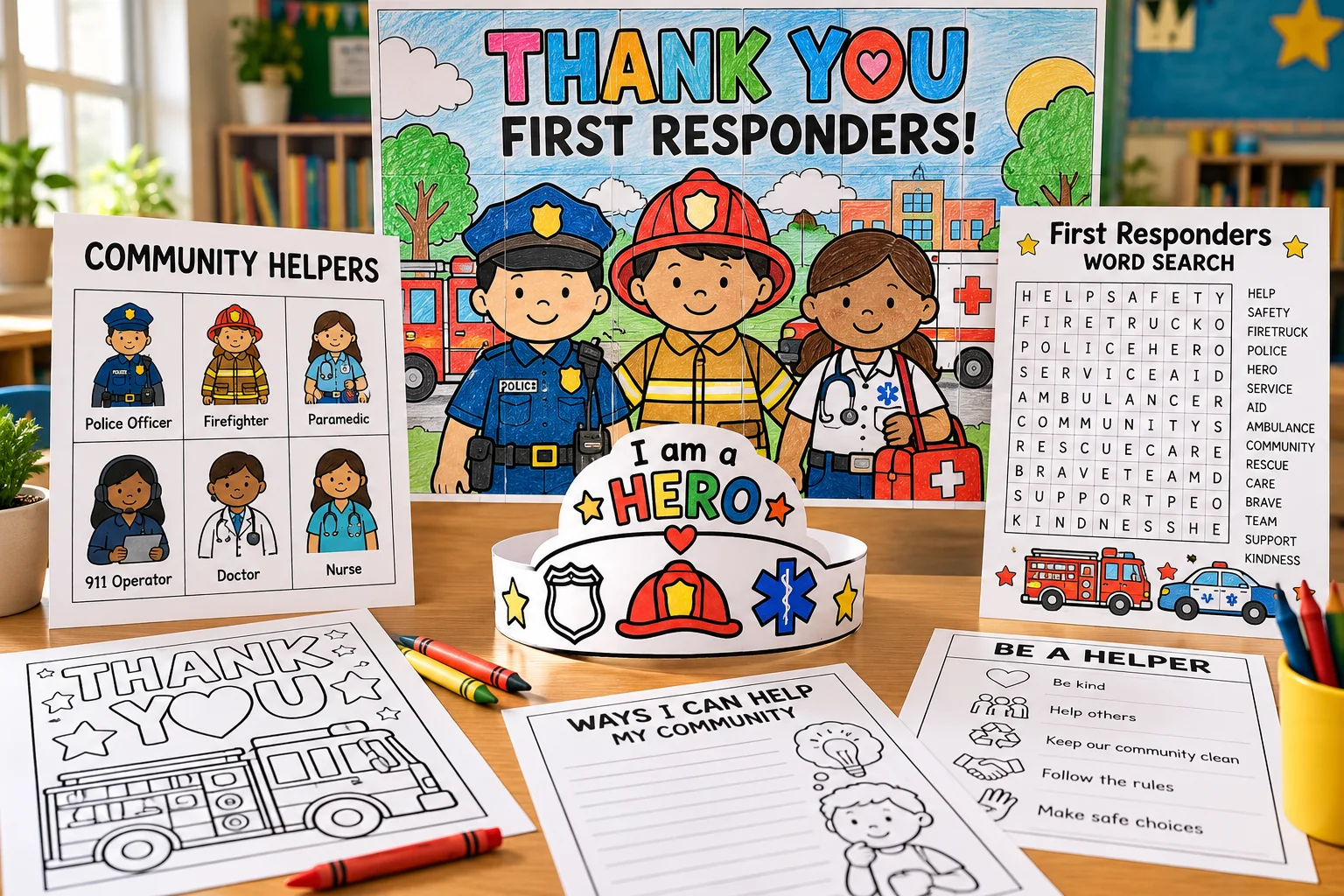
October classrooms get crowded quickly: fall activities, Halloween, Red Ribbon Week, and the final stretch of Bullying Prevention Month all compete for attention. But there is one useful date next week that can fit naturally into reading, writing, social studies, safety, and community-helper units: National First Responders Day on October 28.
The strongest classroom lesson is not simply “color a firefighter and say thank you.” Students can learn who first responders are, what different roles require, why communication matters in an emergency, how communities prepare, and how children can respond safely when they need help.
Current teacher-marketplace resources support that broader approach. Recent materials on TPT combine informational reading, vocabulary, text evidence, writing, and emergency-equipment activities. Tes Resources also carries first-responder materials ranging from early-years crafts to informational displays and reading activities. Teachers and sellers on Eduki can use the same cross-curricular structure for community-helper, English, bilingual, or safety units.
Here are nine practical ways to build a useful lesson or printable pack around the day.
1. Start with “Who responds?” picture sorting
For younger students, begin with jobs rather than definitions. Create large picture cards for firefighters, EMTs or paramedics, police officers, emergency dispatchers, and search-and-rescue workers.
Then create a second set of simple situation cards. Keep them calm and age appropriate: a person feels very sick, smoke is coming from a building, a family needs to call for emergency help, or someone is lost.
Students match the situation to the responder who might help. The important word is might. Real emergencies often involve more than one service, which gives you a natural discussion about teamwork.
For kindergarten and first grade, use pictures and oral discussion. For grades 2–5, add a short written prompt: Why did you choose this responder?
2. Build a “job, tools, skills” organizer
A community-helper lesson becomes more meaningful when students move beyond uniforms and vehicles.
Give each pair or small group one first-responder role and a three-column organizer:
What they doTools they may useSkills they needHow do they help?What equipment helps them work?What must they be good at?
Students might identify communication, teamwork, staying calm, following procedures, physical training, observation, problem solving, or helping people feel safe.
This is a stronger learning target than memorizing vehicle names because it helps students understand why the work requires preparation.
3. Use a short informational reading — then make students use the evidence
Grades 2–5 can handle a short nonfiction passage about how first responders prepare and work together. A good one-page reading might explain that emergency response can involve dispatchers receiving information, responders traveling to the scene, different teams performing different jobs, and communication helping everyone coordinate.
Follow it with only a few questions, but make them useful:
What is the main idea?
Name two different first-responder roles from the text.
Why is communication important during an emergency?
Which detail best shows that first responders need training?
Use two details from the text to explain why teamwork matters.
A current TPT resource for grades 3–5 uses a similar structure: informational passages, comprehension, context-clue vocabulary, a RACE quick write, and an emergency-gear activity. That is a useful model for sellers too — one topic can practice several academic skills without becoming a giant packet of unrelated worksheets.
4. Turn emergency gear into a reasoning activity
Kids are naturally interested in equipment. Instead of a labeling worksheet alone, give students an empty “gear bag” printable.
Ask them to choose a responder and add five items that person might need. Then require an explanation for two choices.
Firefighter: protective helmet — helps protect the head.
Paramedic: medical bag — carries supplies used to help patients.
Dispatcher: headset — helps receive and communicate information.
The point is not to produce an exhaustive or technically perfect equipment list. The learning task is connecting tool → purpose.
For younger children, provide six picture choices and let them cut and paste. Older students can research before completing the bag.
5. Make vocabulary a quick review, not busywork
A focused word list could include emergency, respond, dispatch, rescue, protect, communicate, equipment, prepare, teamwork, community.
After students have encountered the words in a read-aloud or passage, use them in a short word search, matching page, or vocabulary station.
If you are building your own resource, PosterCutter’s Word Search Maker can turn your teacher-selected vocabulary into a printable puzzle and answer key. The useful part still comes from what you add underneath:
Choose three words and explain how they connect.
Which word is most closely related to working together? Why?
Use prepare and emergency in one sentence.
Circle the words that describe actions.
That makes the puzzle a five-minute retrieval activity rather than the entire lesson.
6. Teach what children should do in an emergency
National First Responders Day is a good opportunity to review basic safety without frightening students.
Create a simple “If I need emergency help” sequence appropriate to your school and local guidance. Broad classroom principles can include:
move away from immediate danger when it is safe to do so;
find a trusted adult;
know how to contact the appropriate local emergency service;
give clear information and listen to instructions;
do not interfere with responders who are working.
For younger students, turn this into sequencing cards. For older students, give them calm hypothetical scenarios and ask which step matters first.
The goal is preparedness, not fear. Keep scenarios simple, avoid graphic details, and follow your school’s safety procedures and local emergency guidance.
7. Write a thank-you letter with specific evidence
A thank-you letter is much more valuable when students have learned enough to say something specific.
Instead of “Thank you for being a hero,” provide a simple writing frame:
Opening: Thank you for helping our community.
What I learned: I learned that…
Why it matters: Your work is important because…
Closing: One thing I appreciate is…
Students can write to a local fire station, ambulance service, emergency communications center, or another appropriate community organization if your school has a relationship with one.
If letters will actually be delivered, have the teacher review them first and follow school procedures for contacting outside organizations.
8. Build one collaborative “Our Community Helpers” display
A collaborative poster works especially well here because students can contribute different roles to one final image.
Design a large, simple line-art scene showing several community responders working together — for example, a dispatcher communicating, an ambulance and EMT team, firefighters near a station, and a community safety message. Keep it positive rather than depicting an active disaster.
Each student colors one tile. On the back or on a separate reflection slip, they complete one sentence:
First responders need teamwork because…
One skill that helps in an emergency is…
One way responders help a community is…
One thing I learned today was…
PosterCutter’s Collaborative Poster Maker can split one finished design into ordered student pages, which is useful when you want a whole-class mural without manually cropping dozens of tiles.
For elementary coloring projects, keep the artwork simple: bold outlines, recognizable objects, and large open areas. Dense decorative line art may look impressive in a preview but can make the actual student activity frustrating.
9. Finish with a mini “first responder museum”
If you have two class periods, turn the finished work into a short gallery walk.
Display the job organizers, gear bags, thank-you letters, and collaborative mural. Give students a half-page museum-notes sheet:
Name one first-responder role you learned more about.
Write one tool and explain its purpose.
What skill appeared in more than one job?
What is one thing you should remember in an emergency?
This creates an easy review and gives the display an instructional purpose beyond decoration.
A ready-to-use 45-minute lesson
TimeActivity5 min“Who responds?” picture-card warm-up10 minShort informational reading or read-aloud8 minJob / tools / skills organizer10 minEmergency gear bag reasoning activity8 minThank-you writing or collaborative poster tile4 minExit ticket: “One thing first responders need to work well is…”
If you have only 15 minutes, use the picture sort, discuss one role, and finish with a specific thank-you sentence. If you have a second lesson, add the reading, word search review, and collaborative display.
For teacher-sellers: build a resource around a real classroom outcome
National First Responders Day is a useful product topic because it overlaps several evergreen areas: community helpers, informational reading, safety, writing, careers, and social studies.
That means a resource does not need to disappear after October 28.
Product idea 1: First Responders Reading & Response Pack
3–4 short informational passages at one grade band;
main-idea and supporting-detail questions;
context-clue vocabulary;
job / tools / skills organizer;
RACE or paragraph writing prompt;
answer key.
Product idea 2: Community Helpers Activity Stations
role-and-situation matching;
gear-bag cut-and-paste;
vocabulary puzzle;
thank-you writing station;
emergency-preparedness sequencing;
reflection exit ticket.
Product idea 3: Collaborative First Responders Bulletin Board
Start with original line art, add student reflection cards, a teacher assembly guide, and multiple grid sizes if useful. If your source illustration looks soft at the intended poster size, PosterCutter’s Printable Image Upscaler can help prepare suitable line art or color artwork for print. Always inspect the final file before selling or printing; enhancement cannot restore detail that was never present in a poor source.
When listing on TPT, Eduki, Tes Resources, Etsy, or your own store, show the educational task in the preview. A buyer should immediately see whether students will read, research, sort, write, color, or collaborate — not just see a polished cover.
Design choices that make the printable easier to use
First-responder resources can become visually busy very quickly. Fire trucks, ambulances, badges, helmets, sirens, tools, uniforms, and city backgrounds all compete for space.
For student pages, simplify.
Use one clear task per page.
Give young writers enough actual writing space.
Keep coloring-page outlines bold and open.
Offer grayscale or black-and-white versions when color is not necessary.
Avoid decorative emergency scenes that distract from the learning target.
Use role labels carefully; emergency-service titles and responsibilities can vary by location.
Also avoid presenting every responder as doing the same job. One of the best lessons students can take away is that emergencies require people with different responsibilities working together.
Make appreciation specific
National First Responders Day can certainly include a thank-you card or coloring activity. It just does not have to stop there.
Let students investigate a role, connect equipment to purpose, practice nonfiction reading, think about communication and teamwork, and learn a few calm safety principles. Then the thank-you message has something behind it.
For teachers, that creates a lesson worth using. For teacher-sellers, it creates a resource with value beyond one calendar date — and PosterCutter can handle some of the repetitive production steps while you focus on the educational decisions.