 PosterCutter Blog
A Gratitude Tree That Teaches More Than Gratitude: 5 Low-Prep Printable Activities for October and November
Looking for meaningful fall classroom activities that go beyond coloring worksheets? A classroom gratitude tree can combine writing, vocabulary, social-emotional learning, art, and teamwork in one simple project. Discover five ways to turn printable leaves into a month-long classroom routine, with practical adaptations for different grade levels and ideas for teachers creating their own educational resources.
A Gratitude Tree That Teaches More Than Gratitude: 5 Low-Prep Printable Activities for October and November
October is a great time to begin planning classroom activities for the weeks leading into November.
The excitement of the beginning of the school year has settled. Classroom routines are becoming familiar, and teachers are often looking for activities that feel seasonal without taking an entire afternoon to prepare.
One idea that works particularly well during this time of year is a classroom gratitude tree.
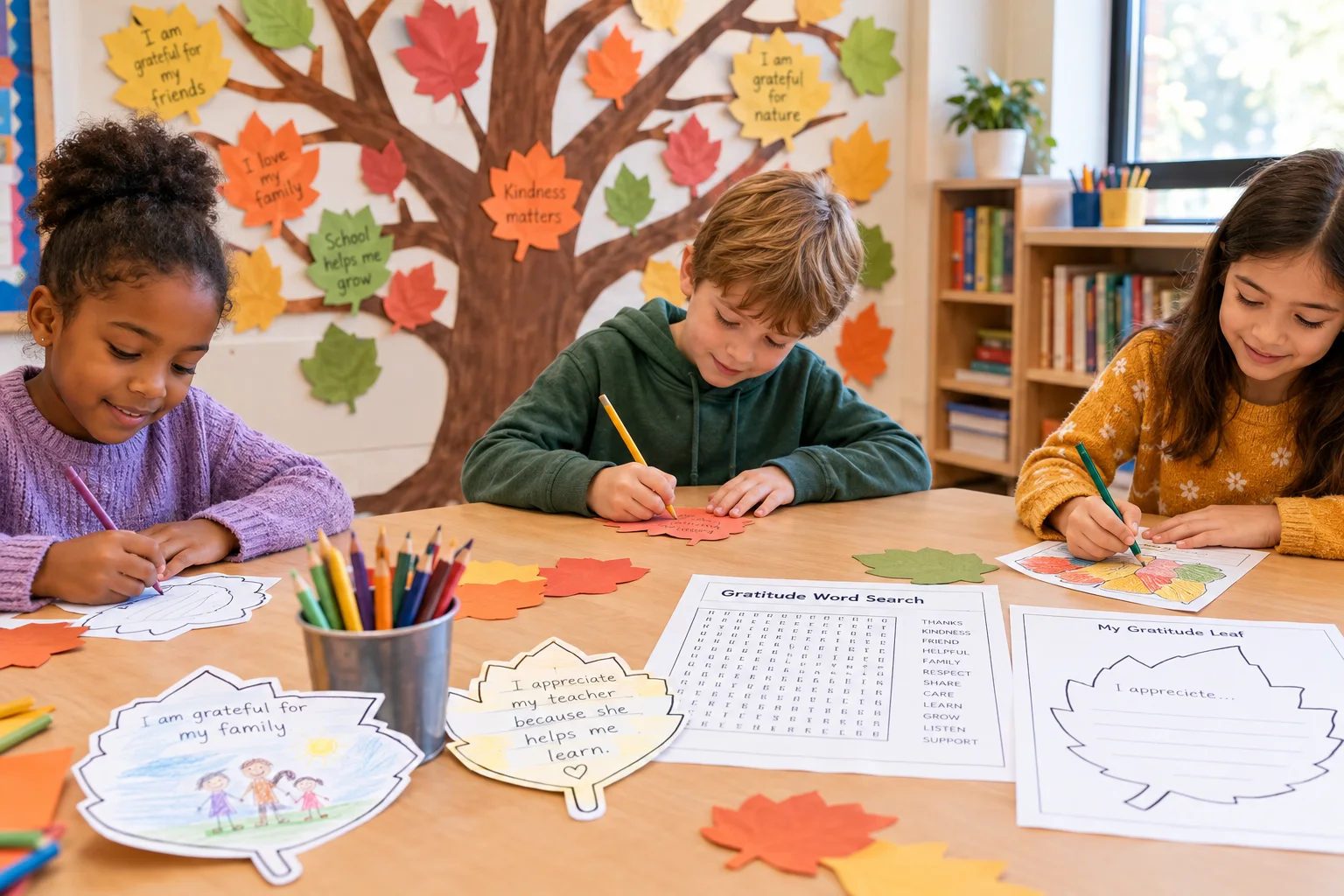
At first, it sounds like a simple bulletin-board activity: students write something they appreciate on a paper leaf and add it to a tree.
But with a little planning, that same activity can support much more than classroom decoration.
Writing practice
Vocabulary development
Speaking and listening
Social-emotional learning
Art
Classroom community
Reflection
Collaborative projects
It also adapts surprisingly well across grade levels.
Younger students can draw pictures or complete simple sentence starters. Older students can explain their thinking, write short paragraphs, discuss kindness, or connect gratitude with actions they can take in their classroom.
The best part is that you do not need an elaborate craft kit.
A few printable pages, pencils, crayons, scissors, and a thoughtful prompt are enough to create a meaningful classroom activity.
Here are five ways to turn a simple gratitude tree into a more useful October or November learning experience.
1. Start With a Simple Gratitude Tree Printable
The easiest version begins with a large tree trunk and branches displayed on the classroom wall.
Then give each student one or more printable leaves.
Students write or draw something they appreciate before adding their finished leaves to the tree.
The activity is simple, but the prompts you choose can completely change the quality of the responses.
Instead of asking every student: "What are you thankful for?" try offering several different prompts.
Gratitude leaf prompts for elementary students
Someone who helped me this week is...
Something I enjoy learning is...
A place where I feel comfortable is...
Something I can do now that was difficult before is...
A kind thing someone did for me was...
Something in nature that I appreciate is...
One thing I like about our classroom is...
Something I would like to thank someone for is...
A book I am happy I discovered is...
Something that made me smile this week is...
These prompts encourage students to think beyond simply naming possessions. They can recognize people, experiences, learning opportunities, progress, kindness, and everyday moments.
For Kindergarten and Grade 1
Keep the prompt extremely simple: "I appreciate..."
Students can finish the sentence with one word, draw a picture, or explain their answer verbally. A large leaf with plenty of drawing space usually works better than a worksheet filled with small decorative elements.
For Grades 2-3
Try: "I appreciate ______ because ______."
This naturally encourages students to explain their thinking rather than writing only one word.
For Grades 4-6
Use a more reflective version: "Something I appreciate is ______. It matters to me because ______."
You can then ask students to add another sentence describing how they could show appreciation.
Keep participation flexible
Not every child will want to write about something personal. Allow students to choose a book, classroom activity, animal, subject, hobby, season, place, or learning experience. Gratitude activities should encourage reflection without making students feel pressured to share private experiences.
2. Turn the Leaves Into a Differentiated Writing Activity
A gratitude tree can easily become a writing lesson without requiring every student to complete exactly the same worksheet.
The simplest way to differentiate the activity is to prepare several versions of the same leaf.
The theme remains consistent, but the writing requirement changes.
Kindergarten and Grade 1
Focus on:
Drawing
Vocabulary
Letter formation
Simple sentence completion
A printable might contain: "I am thankful for ______."
Then provide a large space underneath for drawing.
You could also include a small word bank:
friend
family
teacher
school
book
pet
nature
classroom
Students who are not ready to write independently can draw first and explain their picture afterward.
Grades 2-3
Ask students to write one or two complete sentences.
Example: I appreciate my classroom because I can learn new things with my friends.
At this level, you can also use the activity to reinforce:
Capital letters
Punctuation
Complete sentences
Descriptive vocabulary
Correct spelling of common words
Grades 4-6
Turn the leaf into a short reflection. Ask students to answer three questions:
What do you appreciate?
Why is it important to you?
How can you show appreciation?
The response can become a short paragraph instead of a single sentence.
You could also ask older students to reflect on:
A skill they have improved
A challenge they overcame
Someone who supported them
Something they learned this year
Something they previously took for granted
This gives a simple seasonal printable a genuine literacy purpose.
3. Add a Gratitude Vocabulary Word Search
A gratitude tree becomes even more useful when paired with a short literacy activity.
One easy option is a themed word search.
Instead of choosing random seasonal words, use vocabulary that supports the discussion students will have later.
Gratitude vocabulary ideas
THANKS
KINDNESS
FRIEND
FAMILY
HELPFUL
RESPECT
SHARE
CARE
LEARN
GROW
LISTEN
SUPPORT
SCHOOL
TEACHER
COMMUNITY
For younger learners, keep the grid smaller and use shorter words. For older students, make the puzzle slightly more challenging and include vocabulary students may not immediately use in everyday conversation.
Don't stop after students find the words
The puzzle can become a vocabulary exercise. Ask students to choose three words and use them in complete sentences.
Kindness: I can show kindness by helping someone who is learning a new game.
Respect: We show respect when we listen while another person is speaking.
Support: My classmates support me when we work together.
Teachers creating their own puzzle can use the PosterCutter Word Search Maker to build a printable word search from a custom vocabulary list.
You can create the puzzle around the exact words you are teaching rather than trying to find an existing worksheet that almost matches your lesson.
Always review the puzzle and answer key before giving it to students, especially when preparing materials for younger learners.
4. Build a Collaborative Gratitude Display
Individual leaves are useful, but turning them into a shared project adds another layer to the activity.
Students are no longer creating isolated worksheets.
They are contributing to something that belongs to the entire classroom.
There are two easy approaches.
Option A: Create a growing gratitude tree
Place a large paper tree on the classroom wall. Instead of filling the entire display on the first day, add leaves gradually.
Monday: friendship
Tuesday: learning
Wednesday: kindness
Thursday: nature
Friday: classroom community
By the end of the week, the tree has changed significantly. Students can look at the new leaves, notice similarities between responses, and see how many different things people appreciate. The display becomes part of the lesson rather than simply becoming decoration after the activity is finished.
Option B: Make a collaborative coloring poster
Another approach is to create a large black-and-white illustration that is divided across multiple printable pages.
Each student colors one part. When the pieces are assembled, the class creates one large poster.
You can connect the activity back to gratitude by asking each student to add a short message or printable leaf around the finished poster.
This works especially well when you want a project that combines:
Coloring
Fine motor skills
Cooperation
Classroom organization
Art
Writing
The PosterCutter Collaborative Poster Maker can help turn one finished image into multiple printable pages.
Choose the number of rows and columns, prepare the pages, print them, distribute sections to students, and assemble everything after coloring.
A practical tip
Do not automatically choose the largest possible poster. Think about:
Your number of students
Available wall space
Printer paper size
Assembly time
Whether students will work individually or in pairs
A smaller 12-page or 16-page collaborative poster may be easier to manage than a huge 30-page display.
5. Extend the Activity Into a Kindness Challenge
Gratitude encourages students to notice positive experiences.
Kindness gives them an opportunity to turn reflection into action.
The two concepts are connected, but they are not exactly the same.
Gratitude asks: "What do I appreciate?"
Kindness asks: "What can I do for someone else?"
A simple way to connect them is with printable kindness challenge cards.
Each card contains one realistic action.
Kindness challenge ideas
Invite someone to join a classroom activity.
Help organize shared materials.
Thank someone who helped you.
Listen carefully while someone else is speaking.
Help tidy a classroom area.
Share classroom supplies responsibly.
Give someone sincere encouragement.
Help a classmate understand instructions.
Hold the door for someone.
Leave a positive message for a classmate.
Avoid making the challenge competitive. Students do not need points, prizes, rankings, or leaderboards. The purpose is reflection and practice.
Add a short reflection
At the end of the week, ask:
What did you do?
What happened?
How did the other person respond?
How did you feel?
What would you try next time?
Students can answer in writing, draw a picture, or discuss the questions with a partner. This turns a small printable card into a meaningful classroom conversation.
A Ready-to-Use 25-Minute Gratitude Lesson
You do not need to complete all five activities at once. Here is one possible 25-minute lesson.
Time
Activity
Learning Focus
3 minutes
Introduce gratitude and discuss one example
Speaking and listening
5 minutes
Complete or review gratitude vocabulary
Vocabulary
8 minutes
Complete a gratitude leaf
Writing and reflection
6 minutes
Share selected responses and add leaves to the tree
Classroom community
3 minutes
Choose one kindness action
Planning and reflection
Adjust the timing depending on your students.
Younger children may need more time for coloring and cutting.
Older students may benefit from additional writing time.
You can also spread the project across several days.
Monday - Introduce gratitude vocabulary.
Tuesday - Complete gratitude writing leaves.
Wednesday - Add a kindness activity.
Thursday - Work on collaborative poster pieces.
Friday - Assemble the display and reflect as a class.
This approach keeps preparation manageable while allowing the theme to continue throughout the week.
What Teachers Should Check Before Printing
Good classroom printables are usually simple. The challenge is making sure they are easy to use. Before printing a gratitude activity, check the following.
Readable instructions
Students should understand what they need to do without spending several minutes decoding the worksheet.
Enough writing space
A Grade 1 student and a Grade 5 student do not need the same amount or type of writing space. Make the worksheet appropriate for the intended age group.
Printer-friendly pages
Avoid unnecessary full-page backgrounds. Black-and-white printables are often useful because students can color them themselves.
Clean image quality
Printables should have sharp lines and readable text. If a source image is small or blurry, enlarging it directly inside a document can produce fuzzy outlines when printed.
For image-heavy worksheets, coloring pages, posters, or classroom graphics, you can use the PosterCutter Printable Image Upscaler before placing the artwork into your final printable layout.
The important part is to check the final output at full size. Do not assume an image is print-ready simply because it looks fine when displayed small on your screen.
Flexible participation
Allow students to:
Write
Draw
Dictate
Choose different prompts
Share privately instead of publicly
Appropriate lesson length
Remember that coloring, cutting, organizing, and assembling materials takes time. A worksheet that looks like a 10-minute activity may easily become a 25-minute lesson after classroom transitions are included.
A Product Idea for Teachers Who Sell Printables
If you create resources for other teachers, the same gratitude-tree concept can become a useful seasonal product.
Rather than creating one isolated worksheet, consider developing a small resource collection around one classroom theme.
Page 1 - Teacher instructions
Pages 2-4 - Differentiated gratitude writing leaves
Pages 5-6 - Blank leaf templates
Page 7 - Gratitude vocabulary word search
Page 8 - Word search answer key
Pages 9-12 - Kindness challenge cards
Pages 13-16 - Collaborative poster sections or display elements
That creates a more complete classroom activity while keeping every page related to the same learning objective.
You could also provide:
US Letter version
A4 version
Color version
Black-and-white version
Primary writing version
Older-student writing version
Think like the teacher downloading your resource
Teachers purchasing resources from Teachers Pay Teachers, Eduki, or Tes Resources usually want to understand very quickly what they are downloading.
Make your product description clear. Include:
Recommended grade level
Number of pages
File format
Printing instructions
What is included
Whether an answer key is provided
Whether the resource is color or black and white
Whether Letter and A4 versions are included
Avoid describing a resource as differentiated unless the files genuinely include meaningful adaptations. Your preview images should also represent the actual resource accurately.
If you are building image-heavy resources, collaborative classroom displays, coloring pages, or other printables, PosterCutter's tools can help with specific parts of the preparation process rather than replacing the educational work behind the resource.
You can browse PosterCutter's classroom printables and educational resources for ideas and examples.
The goal should not be to make the largest bundle possible. It should be to create something that another teacher can understand quickly, print easily, and use successfully.
How to Make the Activity Reusable Beyond November
One of the best things about this project is that the structure can be reused throughout the school year. You do not necessarily need to keep the autumn theme.
December - A kindness tree
January - A classroom goals tree
February - A friendship tree
March - A growth-mindset tree
April - An Earth Day action tree
May - A "What I Learned This Year" tree
The printable structure stays almost identical. Only the prompts and visual theme change. That makes the activity especially useful for teachers who prefer reusable routines rather than completely new lesson formats every month. Students already understand the process, which also reduces explanation time.
Final Thoughts
A gratitude tree does not need elaborate artwork, expensive supplies, or a complicated lesson plan to be meaningful.
Start with one clear prompt.
Give students an appropriate way to respond.
Then let the classroom display grow gradually.
If you have additional time, extend the activity with vocabulary practice, differentiated writing, a collaborative poster, kindness cards, small-group discussion, or reflection writing.
Each extension gives students another way to explore the same central idea.
For October and November classrooms, that combination of seasonal interest, writing practice, art, vocabulary, and classroom community makes a gratitude tree much more useful than a simple decorative craft.
And if you are preparing your own classroom printables, explore PosterCutter's educational resources and printable tools that can help turn finished designs into classroom-ready materials.