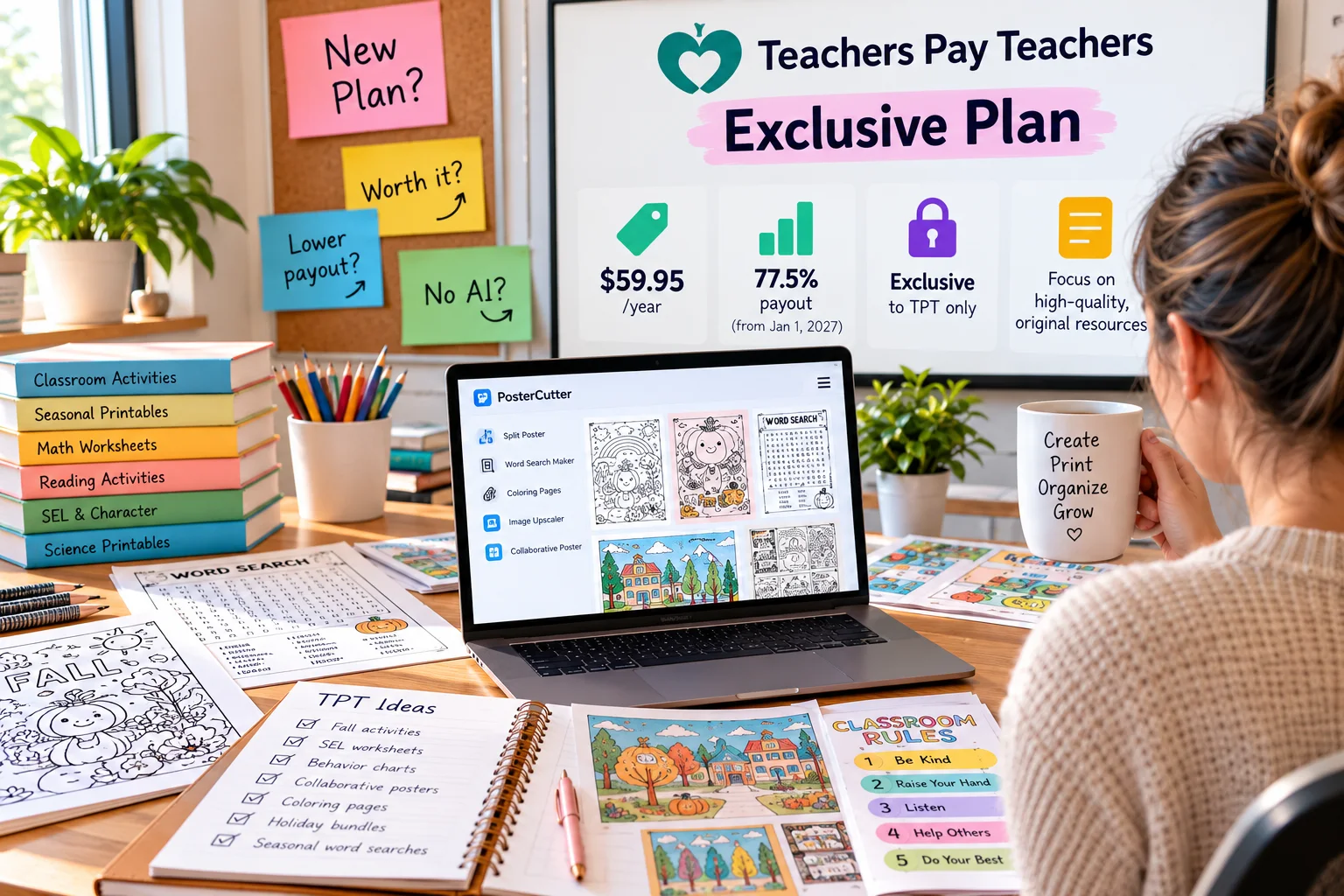
PosterCutter Blog
Why Are TPT Seller Accounts Getting Closed? What Sellers Report, What TPT Says, and the AI Question
Recent TPT seller discussions include repeated claims of stores being suspended or closed with little specific explanation, inaccessible dashboards, and unresolved payout questions. This investigation separates verified TPT policy from seller reports, examines where AI may fit into the picture, and gives teacher-authors a practical plan for protecting their original files, licenses, earnings records, and business continuity.
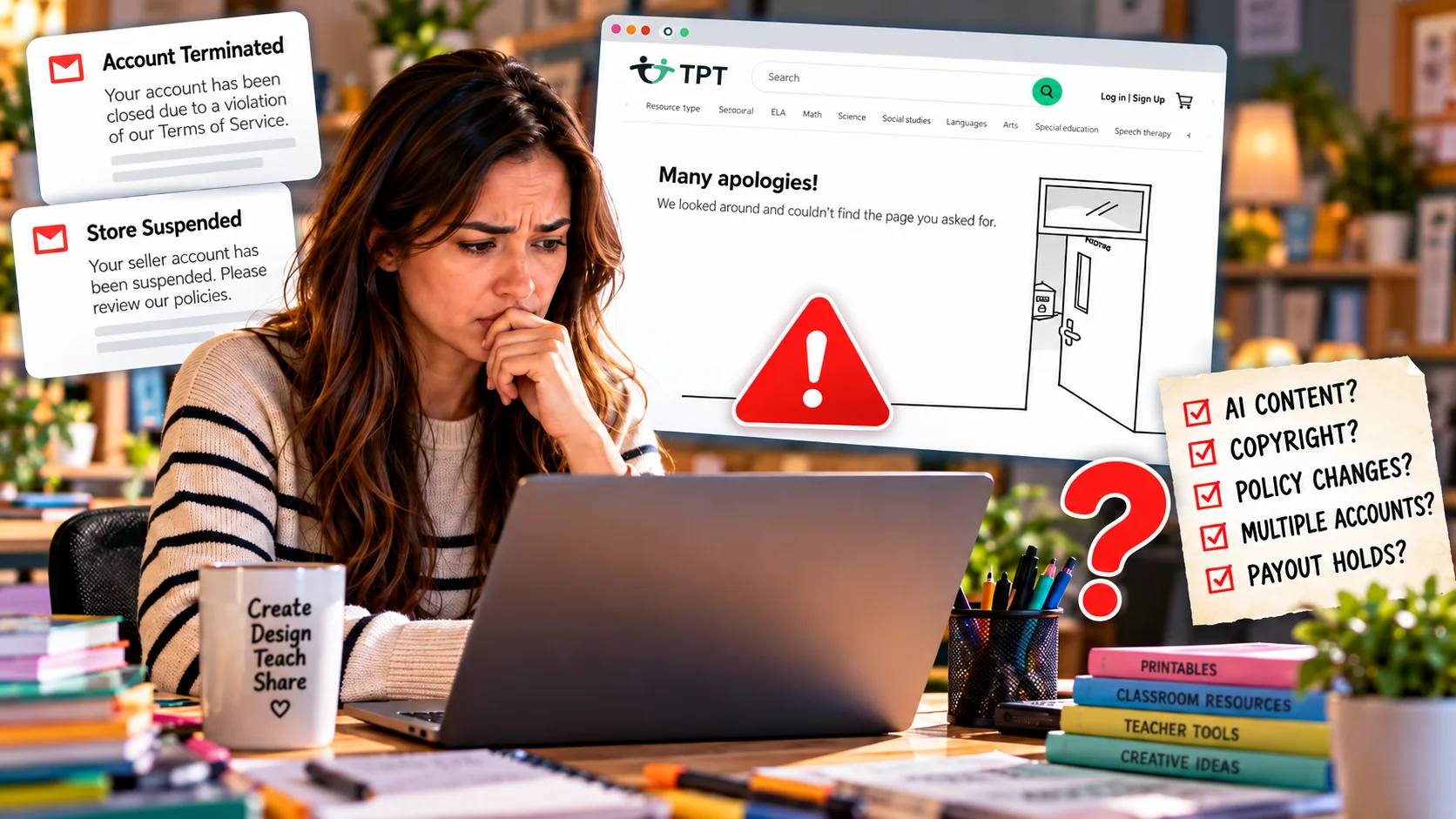
Something uncomfortable has been showing up again and again in teacher-seller conversations: a TPT store disappears, the seller loses access to the dashboard, the explanation is vague, and the seller is left trying to work out what happened.
Some sellers say they were told only that their account violated platform rules. Others report unanswered support tickets, missing access to sales history, or uncertainty about money that had not yet been paid out.
It is important not to overstate what those stories prove.
A missing storefront does not automatically mean TPT wrongfully terminated an account. A page can disappear because a product was removed, a URL changed, the seller deleted something, or the account itself was suspended or closed. A Reddit post or review is also evidence of what a seller says happened, not independent verification of every detail.
But the pattern raises a question teacher-authors should take seriously:
How much of your business would survive if your marketplace account disappeared tomorrow?
That question matters even more now because TPT is simultaneously tightening its seller ecosystem, introducing Exclusive Seller membership, and signaling a much stricter direction on generative AI.
The problem is not just account closures. The problem is building a business where your products, records, audience, and production workflow all depend on systems you do not control.
What TPT’s Terms Actually Allow
TPT’s current Terms of Service give the company broad authority over accounts.
The Terms state that TPT may close or suspend a member account “at any time for any reason, with or without notice.”
That surprises many sellers because it means a warning period, detailed accusation, or opportunity to correct the problem is not guaranteed by the public Terms.
Once an account is closed, the seller’s resources are no longer searchable and their resource pages are no longer available to new buyers. Customers who previously purchased paid resources may still retain access to those past purchases.
This does not tell us whether every closure is fair. It simply tells sellers what level of discretion the marketplace has reserved for itself.
What Happens to Unpaid Earnings?
Payouts are one of the most emotional parts of current seller discussions.
TPT says seller earnings are normally paid monthly, and its Terms allow payouts to be delayed or withheld while the company believes a seller may be violating its rules.
The Terms also state that after the issue is resolved, TPT will either refund associated sales or complete the payout.
That is different from saying that every closed store immediately loses all outstanding earnings.
The difficulty for a seller is practical: once dashboard access disappears, they may also lose convenient access to the very records needed to understand sales, pending payouts, refunds, and product history.
That is one reason sellers should stop treating marketplace dashboards as permanent archives.
What Sellers Are Reporting
There is no reliable public dataset showing how many TPT stores are being closed, why each one was closed, or how many decisions are later reversed.
What does exist is a growing collection of public seller reports.
“My store vanished and I was not told exactly why.”
Recent discussions in the TeachersPayTeachers subreddit include sellers who say their accounts were suspended while they were given only broad references to platform policies.
Some report receiving an initial support acknowledgment but no detailed explanation identifying the exact resource, image, description, or behavior that caused the action.
“I still had earnings pending.”
Other public complaints focus on unpaid balances. Sellers describe losing dashboard access while still receiving evidence of prior sales or while expecting an upcoming payout.
Recent Trustpilot reviews contain similar claims from sellers who say they operated stores for years before losing access and then struggled to get specific answers.
Again, these are self-reported accounts. They should be read as evidence of seller concern, not proof that every enforcement decision was incorrect.
AI Is Now One of the Biggest Risk Questions
The AI issue became much more serious after TPT’s October 2026 seller communications.
Independent recaps of TPT’s October Seller Town Hall report that the company wants the marketplace to move toward resources that are teacher-created, classroom-ready, and free from generative AI content.
Sellers were reportedly told to move away from generative AI in:
resource text;
illustrations;
covers;
thumbnails;
preview files;
and product descriptions.
That direction follows earlier concern about low-quality AI-generated educational content. In August 2026, Chalkbeat reported on low-quality AI-generated materials appearing on TPT, including obvious factual and visual errors.
The important point is not that every recent closure is caused by AI. There is no evidence for that.
The important point is that sellers who built large parts of their workflow around generative AI now face a much more uncertain environment.
Why “Hiding the AI” Is the Wrong Response
When sellers become worried about enforcement, the internet quickly fills with bad advice:
remove metadata;
rewrite the text until detectors stop flagging it;
run AI images through another filter;
upscale or alter the file;
or change the design enough that it looks different.
That solves the wrong problem.
If a marketplace rule prohibits the underlying content, changing its appearance does not change how it was created.
The stronger long-term move is to replace questionable source material with content that is genuinely yours or clearly licensed for your use.
This is where PosterCutter should be understood correctly.
PosterCutter is not a way to hide AI. PosterCutter is a way to build a better production workflow around original content.
Why PosterCutter Is Part of the Solution for Teacher Sellers
The biggest lesson from the current TPT anxiety is not simply that marketplaces can be unpredictable.
It is that sellers need a better foundation.
If your store depends on AI-heavy shortcuts, unclear asset rights, poor file organization, and a dashboard you do not control, your business is fragile even if the account never gets suspended.
PosterCutter helps solve a different part of the problem: it gives teacher-authors a structured way to turn their own educational ideas and original assets into finished printable products.
1. Create original products instead of chasing shortcuts
A teacher-seller can begin with something they genuinely created:
a vocabulary list;
a classroom poster;
hand-drawn line art;
original educational questions;
a lesson concept;
or a classroom activity sequence.
The educational value still comes from the seller.
PosterCutter then helps with the repetitive production layer.
2. Turn your own vocabulary into a finished printable
If you create the vocabulary yourself, the PosterCutter Word Search Maker can turn it into a printable puzzle and matching answer key.
You decide the subject, grade level, learning objective, vocabulary, and follow-up activity. PosterCutter handles the puzzle-building work.
That is a much more defensible workflow than asking a generator to create an entire educational product and uploading the result without meaningful review.
3. Turn original artwork into a classroom-ready poster
If you draw or legally license a finished design, the PosterCutter Printable Poster Maker can divide it into standard printer pages.
This lets one original illustration become:
a bulletin-board display;
a collaborative classroom poster;
a multi-page coloring activity;
or a large-format printable resource.
You are creating more value from a source asset you actually control.
4. Prepare your own artwork for better printing
Teacher-authors often create artwork that looks fine on screen but prints poorly because the original file is too small.
The PosterCutter Printable Image Upscaler can help prepare suitable original or properly licensed artwork for cleaner classroom printing.
The distinction matters:
Upscaling your own artwork is production. Upscaling prohibited AI artwork does not change its origin.
5. Build products around repeatable systems
A strong teacher-seller workflow should not begin with “What can AI generate for me today?”
It should begin with:
What does the teacher need?
What educational content am I creating?
What assets do I own or have permission to use?
What printable format best solves the classroom problem?
Which production steps can a tool automate safely?
PosterCutter fits in step five.
That is why it can become a safer long-term production system rather than another shortcut.
What a Safer PosterCutter-Based Workflow Looks Like
Imagine you want to make a fall vocabulary resource.
A risky workflow might look like this:
Generate the worksheet → generate the images → generate the description → upload everything.
A stronger workflow looks like this:
Choose the grade and learning objective yourself.
Create the vocabulary list yourself.
Write the student instructions yourself.
Create or properly license the artwork.
Use PosterCutter to generate the word-search layout or poster pages.
Review the entire resource as a teacher would use it.
Export the final printable.
Keep the editable source files and license records.
Write an accurate listing description.
The difference is not simply “human versus software.”
The difference is that the important educational and authorship decisions remain traceable to you.
PosterCutter Can Also Help You Build Outside a Single Marketplace Mindset
PosterCutter cannot protect a TPT account from suspension, and no legitimate tool should promise that.
What it can do is help you create resources in a workflow that exists independently of the marketplace dashboard.
Your source file stays yours.
Your original artwork stays yours.
Your vocabulary stays yours.
Your exported printables stay yours.
Your product-production process still exists if one marketplace changes its rules.
That matters increasingly in a world where teacher-sellers may choose between TPT Basic, TPT Exclusive, Eduki, Tes Resources, Etsy, or their own website.
TPT Exclusive Sellers will have restrictions on selling eligible digital educational resources elsewhere, so sellers should always check the current membership rules before distributing the same resource across platforms.
What Every Seller Should Back Up Now
Whether or not you use PosterCutter, do not let the only copy of your business live inside TPT.
Keep local or independent cloud copies of:
every final PDF;
editable source files;
cover images;
preview files;
product descriptions;
commercial-use licenses;
font licenses;
clip-art receipts;
sales reports;
payout records;
tax documents;
and important support correspondence.
If something goes wrong, these records are your reconstruction kit.
Audit AI Use Before Enforcement Forces You To
Create a spreadsheet of your existing products.
For each product, check:
resource text;
illustrations;
cover;
thumbnail;
preview;
description;
and third-party assets.
Mark anything created with generative AI or anything where the origin is uncertain.
If TPT’s final policy prohibits a particular use, rebuild that part of the product.
PosterCutter can then help turn the replacement material into the finished printable format.
Copyright May Be an Even Bigger Risk Than AI
AI is dominating the conversation, but established intellectual-property rules remain a major source of marketplace risk.
TPT’s Seller Guidelines require sellers to have the necessary rights to everything included in a resource.
That includes:
clip art;
fonts;
photographs;
characters;
logos;
song lyrics;
passages;
and commercial templates.
A resource can be completely human-made and still violate intellectual-property rules.
Originality and licensing are separate questions. Sellers need both.
If Your TPT Account Is Already Closed
If you have already lost access, do not immediately create another seller account or begin changing evidence.
Instead:
Save the termination or suspension email exactly as received.
Take screenshots of the inaccessible store or dashboard.
Collect sales notifications and payout records.
Write down your expected unpaid balance.
Gather source files and licenses for the products most likely to be questioned.
Contact TPT through the official support channel.
Ask for the specific policy basis, payout status, and available next step.
Save every support ticket and reply.
If a substantial amount of money is involved, seek appropriate professional advice in your jurisdiction rather than relying only on social-media advice.
The Bigger Lesson: Build a Business You Can Reconstruct
Sellers cannot control every marketplace policy change.
They cannot control every moderation system.
They cannot guarantee that a support decision will go the way they expect.
What they can control is how they build.
A seller with original source files, clear commercial rights, local backups, documented product history, and a repeatable production process is in a much stronger position than a seller whose entire operation depends on one marketplace login and a folder of AI outputs.
That is the real value of a tool like PosterCutter.
It is not a loophole.
It is not an AI detector bypass.
It is not a guarantee against marketplace enforcement.
It is a production system that helps teacher-authors turn their own ideas and assets into classroom-ready printable products more efficiently.
Conclusion
The current TPT closure complaints raise legitimate questions about transparency, seller communication, payout handling, intellectual property, and how the platform will enforce its changing AI standards.
But waiting for perfect clarity is not a business strategy.
The safer response is to move toward products you can document and defend.
Create the educational idea yourself.
Write the content.
Use artwork you created or clearly have permission to use.
Keep your source files.
Keep your licenses.
Keep your sales records.
Then use tools like PosterCutter to handle the repetitive production work around that original content.
That gives teacher-sellers something much more valuable than a temporary workaround: a cleaner, stronger, more resilient printable-resource business.
Explore PosterCutter and build your next printable from content you actually control.
Sources and Method
This article separates official platform policy from public seller reports. TPT policy references should be checked against the current Terms of Service, Seller Guidelines, Content Guidelines, payout documentation, and Exclusive Seller FAQs.
Seller experiences discussed in public forums and review sites are treated as self-reported experiences rather than independently verified findings.
AI context also draws on public reporting about low-quality AI-generated educational resources and current seller-policy discussions. Sellers should check TPT’s latest written AI guidance before making final compliance decisions.