 PosterCutter Blog
TPT Exclusive Seller Membership 2027: What Changed, Why It Matters, and What Sellers Should Do About AI
TPT is replacing Premium Seller membership with a new Exclusive Seller tier. Here is what the 77.5% payout, platform exclusivity, Basic option, seller reaction, and TPT's newly announced AI direction mean for teacher-authors — plus a practical workflow for sellers who need to move away from AI-generated product content.
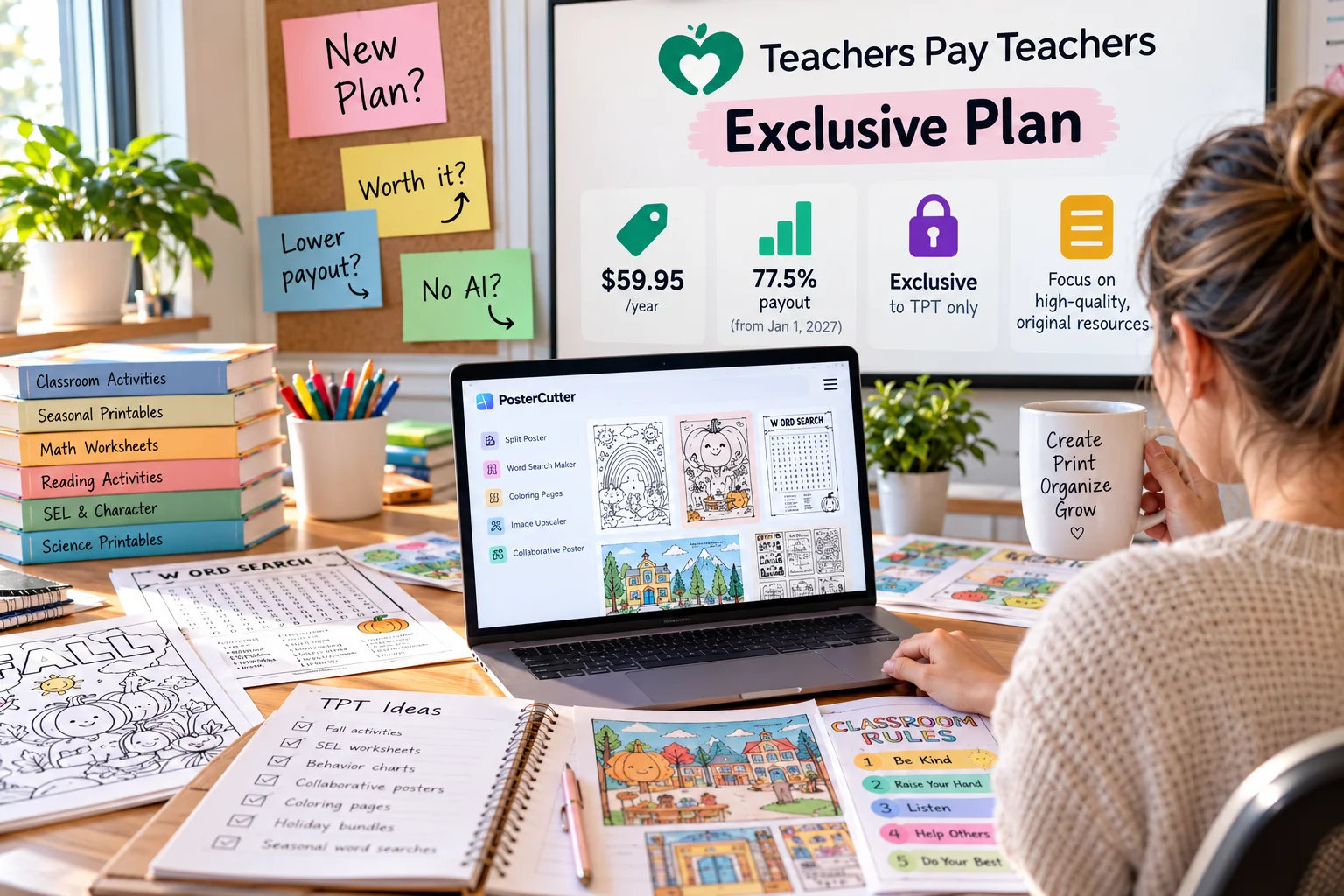
Teachers Pay Teachers has made one of its biggest seller-side changes in years.
On October 1, 2026, TPT announced that its Premium Seller membership is being replaced by a new Exclusive Seller membership. For existing Premium Sellers, the change fully takes effect on January 1, 2027. New and Basic Sellers can already choose the Exclusive option.
The headline is simple: sellers can still get a much higher payout than Basic Sellers, but in exchange they must make TPT the exclusive sales platform for their eligible digital educational resources.
At almost the same time, TPT used its October 8 Seller Town Hall to announce a much tougher direction on generative AI. According to multiple recaps of the Town Hall, TPT said it wants the marketplace to be teacher-created, classroom-ready, and AI-free, and told sellers to begin moving away from AI-generated text and images.
Those are technically two separate changes. But together, they raise a much bigger question for teacher-authors:
What kind of TPT business do you want to build in 2027?
What Exactly Is the New TPT Exclusive Seller Membership?
TPT now offers two seller paths: Basic Seller and Exclusive Seller.
FeatureBasic SellerExclusive SellerMembership fee$29 one-time$59.95 per yearPayout rate55%77.5% from January 1, 2027Introductory 2026 rateNot applicable80% through December 31, 2026 for qualifying sign-upsTransaction fee$0.30 per resource$0.15 per resource only on orders totaling under $3Sell eligible digital education resources elsewhere?YesNoPremium seller toolsNoYes
For current Premium Sellers, the important date is January 1, 2027. TPT says Premium Sellers remain at the existing 80% payout through December 31, 2026. After that, sellers who opt into Exclusive move to 77.5%. Sellers who do not opt in transition to Basic.
For the latest details, check TPT's official Seller Fees and Payout Rates page and its Exclusive Seller announcement.
What Does “Exclusive” Actually Mean?
Exclusive does not mean you have to delete your website, stop using social media, or stop marketing outside TPT.
TPT says Exclusive Sellers may continue running their own sites and promoting their products elsewhere. The restriction is on the sale of TPT-eligible digital educational resources.
If a resource is eligible to be sold on TPT, an Exclusive Seller generally cannot also sell that same type of digital educational resource through Etsy, Eduki, Tes Resources, a personal checkout, or another digital teaching-resource marketplace. The purchase has to be processed through TPT.
If you are considering Exclusive status, read TPT's current Exclusive Seller FAQ rather than relying only on social posts or screenshots.
Why Is TPT Doing This?
TPT's own explanation is about marketplace concentration.
In its announcement, TPT says more TPT resources are increasingly being sold on sites outside TPT. The company argues that keeping more eligible educational resources inside one marketplace can create a stronger cycle: buyers return to TPT, discover more sellers, make more purchases, and give TPT more reason to invest in product features and marketing.
Exclusive Sellers are promised access to tools and benefits such as Search Analytics, Keyword Finder, additional promotional features, marketing data, and the possibility of inclusion in TPT-funded campaigns.
From TPT's perspective, the exchange is:
Higher seller payout + premium tools → in exchange for marketplace exclusivity.
From a seller's perspective, the trade is more complicated because exclusivity has an opportunity cost. A teacher-author who also sells well on another platform has to consider revenue that could be lost outside TPT, not just the difference between 55% and 77.5%.
What Are Sellers Saying?
There is no reliable public poll showing what the entire TPT seller community thinks. Public discussions are also naturally more likely to attract people who feel strongly about a change.
Still, the seller conversations visible since the announcement show several recurring reactions.
1. “Why Am I Giving Up Other Marketplaces and Receiving a Slightly Lower Rate Than Premium?”
This is one of the most visible criticisms.
Premium Sellers previously received 80% without agreeing to marketplace exclusivity. The new long-term Exclusive payout is 77.5%. Some sellers therefore see the change as asking them to give up distribution freedom while TPT also increases its percentage of each sale.
2. “TPT Traffic May Still Make Exclusive Worth Considering.”
Other sellers are more cautious about immediately rejecting the plan.
TPT is not just a file-hosting service. It is also a marketplace with existing buyer traffic, search behavior, ratings, seller history, and product discovery. A seller whose business depends heavily on organic TPT traffic may not be able to reproduce that traffic simply by uploading the same files elsewhere.
3. “I Do Not Want One Marketplace to Control My Entire Digital-Product Income.”
For sellers already active on Etsy, Eduki, Tes Resources, their own shops, or regional teacher marketplaces, the main concern is business concentration.
An Exclusive Seller can still build an email list, publish a blog, grow a social following, sell permitted products, and maintain a website. But eligible digital educational resources need to route back to TPT.
4. “The AI Announcement Changes the Conversation Again.”
The October 8 Town Hall added another layer.
Independent recaps of the Town Hall report that TPT told sellers to stop using generative AI to create text or images for resource files and listings, including covers, thumbnails, previews, and descriptions.
The practical message is difficult to miss: TPT is signaling that it wants the value of the marketplace to come from teacher-created resources rather than mass-produced AI content.
If You Used AI to Create TPT Products, Do Not Try to “Hide the AI”
This is the point where some sellers may be tempted to look for an AI detector remover, metadata cleaner, image filter, or rewriting tool that supposedly makes AI-generated material look human.
That is the wrong workflow.
Changing the resolution, removing metadata, rewriting a few sentences, or passing an image through another tool does not change where the underlying content came from.
If TPT's final written policy follows the direction announced at the Town Hall, the safer long-term strategy is to replace AI-generated product content with your own original teacher-created material.
That is also where PosterCutter can be useful — not as a way to disguise AI content, but as a way to rebuild the production process around original material.
Where PosterCutter Fits for Sellers Moving Away From AI-Dependent Workflows
PosterCutter is most useful after the educational idea and source material are yours.
Think of it as a production workflow rather than a content-authorship shortcut.
Original Vocabulary → Printable Word Search
If you create your own vocabulary list for a science unit, seasonal lesson, reading activity, or classroom topic, you can turn that teacher-selected vocabulary into a printable puzzle using the PosterCutter Word Search Maker.
The educational choices — topic, grade level, vocabulary, definitions, follow-up questions, and teaching purpose — still come from you.
Original Artwork → Collaborative Classroom Poster
If you draw or design your own classroom illustration, the PosterCutter Collaborative Poster Maker can divide it into student-sized printable sections.
That gives you a practical way to create a collaborative poster product without needing generative AI to produce the finished classroom resource.
Your Own Scans or Line Art → Print-Ready Preparation
If you create coloring artwork yourself and the scan is too small for a clean Letter or A4 printable, the PosterCutter Printable Image Upscaler can help prepare the file for printing.
But there is an important distinction: upscaling is a production step. It does not convert AI-generated artwork into original human-created artwork, and sellers should not use it as a way to bypass marketplace rules.
Finished Original Resource → Better Packaging
Once the educational content is original, sellers can spend more time on the parts that genuinely improve buyer experience:
clear printable dimensions,
clean black-and-white pages,
Letter and A4 versions where useful,
accurate previews,
answer keys,
teacher instructions,
age and grade recommendations,
and readable product organization.
You can also browse PosterCutter Explore for printable formats and classroom-resource inspiration.
A Practical Audit for Sellers Who Already Have AI-Assisted Products
If you have a large store, do not randomly start deleting products.
Build an inventory first.
Step 1: Audit the Resource File
Check whether generative AI was used for:
illustrations,
coloring pages,
reading passages,
questions and answer keys,
lesson-plan text,
worksheets,
or classroom examples.
Step 2: Audit the Listing Itself
Do not forget:
cover images,
thumbnails,
preview files,
product descriptions,
and marketing graphics.
Step 3: Keep Your Original Source Files
Save drafts, editable files, sketches, source documents, original photographs, licensed asset records, and other evidence of how you created the resource.
Step 4: Rebuild Rather Than Disguise
Where AI-generated material exists, replace it with material you created yourself or content you have clear rights to use.
Step 5: Wait for the Written AI Policy Before Assuming Edge Cases
Questions sellers may reasonably want clarified include whether the final policy distinguishes between generative creation and assistive tools such as grammar checking, background removal, OCR, image cleanup, or non-generative automation.
Until those details are published, avoid presenting uncertain interpretations as settled rules.
Should You Choose Basic or Exclusive?
There is no single answer for every seller.
Exclusive may be worth evaluating if:
most of your digital-resource revenue already comes from TPT,
you rely heavily on TPT search and buyer traffic,
you are comfortable routing eligible digital educational sales through TPT,
and the higher payout rate outweighs what you would realistically earn elsewhere.
Basic may deserve consideration if:
you actively sell digital educational resources across several marketplaces,
your own store is an important part of your revenue,
you want freedom to experiment with Eduki, Tes Resources, Etsy, or other channels,
or distribution flexibility is more valuable to you than TPT's higher Exclusive payout.
Do the calculation with your own numbers.
A seller earning almost everything from TPT is making a different decision from a seller whose TPT store represents only one part of a diversified business.
The Bigger Shift: TPT Wants a More Controlled Marketplace
The Exclusive Seller membership and the new AI direction are separate policies, but they point in a similar strategic direction.
TPT wants more eligible educational transactions to stay inside TPT, and it is also signaling that it wants the products themselves to feel more distinctly teacher-created.
For sellers, that makes original educational value more important — not less.
A worksheet should solve a classroom problem.
A coloring activity should have clean printable artwork.
A word search should reinforce meaningful vocabulary.
A collaborative poster should fit an actual classroom workflow.
A listing should accurately explain what the teacher receives.
That is a harder business to automate completely, but it is also a more defensible one.
Conclusion
The new TPT Exclusive Seller membership is not simply a new subscription price.
It changes the relationship between TPT and sellers who want the platform's highest payout rate. Beginning in 2027, that higher rate comes with exclusivity for eligible digital educational resources.
Seller reaction has been understandably divided: some see a loss of flexibility and a smaller payout than the old Premium tier, while others recognize that TPT's existing marketplace traffic may still make the Exclusive option economically important to their stores.
Then there is AI.
The direction announced at TPT's October 8 Town Hall means sellers who built products heavily around generative AI should start thinking about a different production model.
The answer is not to make AI content harder to detect.
The better move is to make the underlying educational product genuinely yours.
Create the vocabulary. Write the questions. Draw or license the artwork properly. Test the printable. Build the answer key. Add teacher instructions. Then use workflow tools such as PosterCutter to handle the repetitive production work around that original content.
That approach gives sellers something much more useful than a temporary workaround: a resource business built around material teachers can actually use.