 PosterCutter Blog
World Food Day 2026 Classroom Activities: 9 Meaningful Printables for October 16
World Food Day is October 16, and the 2026 theme — “Innovate today. Nourish tomorrow.” — gives teachers an unusually good bridge between literacy, science, geography, sustainability, and creative problem-solving. Here are nine low-prep printable activities that keep the learning meaningful, plus practical ways to adapt them for grades 2–6.
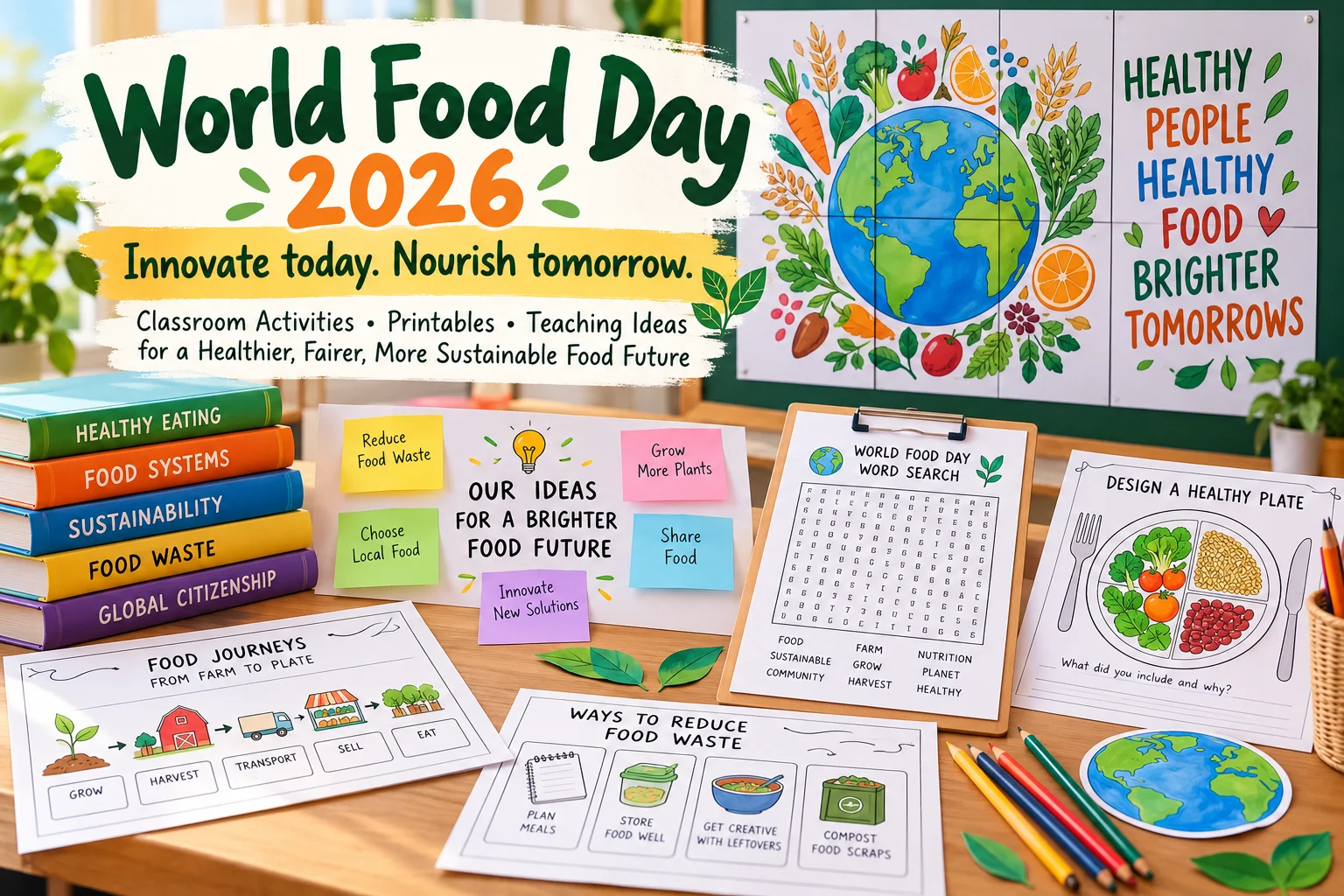
If you need a useful October lesson for this week, World Food Day is one of those calendar moments that can do much more than fill a seasonal worksheet slot. It falls on October 16, and the official 2026 theme from the UN Food and Agriculture Organization (FAO) is “Innovate today. Nourish tomorrow.”
That theme is especially classroom-friendly because “innovation” does not have to mean robots or futuristic farms. FAO describes it broadly: forward-looking solutions can work alongside traditional knowledge and inclusive approaches to improve access to sufficient, diverse, safe, and nutritious food while protecting the planet.
For teachers, that opens the door to reading, vocabulary, science, geography, persuasive writing, design, and problem-solving — all from one topic. Below are nine printable-friendly activities for roughly grades 2–6. Pick one for a 20-minute lesson, combine three into stations, or turn the ideas into a small World Food Day resource pack.
1. Start With a “How Did My Lunch Get Here?” Map
Before introducing global food systems, start with something students already understand: lunch. Give each student a simple page with a plate in the center and four boxes around it:
Where might it have grown or been made?
Who helped produce it?
How might it have traveled?
What happened before I ate it?
A banana, loaf of bread, carton of milk, bowl of rice, or tomato can become a surprisingly rich discussion. Younger students can draw the journey. Older students can add farmers, processing, packaging, transport, shops, refrigeration, and waste.
The goal is not to trace every product perfectly. It is to help students notice that food reaches us through a system involving people, natural resources, knowledge, and infrastructure.
Easy extension
Ask students to circle one stage where an improvement could reduce waste, save water, shorten transport, improve safety, or help people. That immediately connects the activity to the 2026 idea of innovation.
2. Build a World Food Day Vocabulary Puzzle
A vocabulary activity works well as morning work, a literacy center, or a follow-up after a short reading. Useful words might include agriculture, harvest, nutrition, sustainable, farmer, innovation, community, compost, seasonal, waste, soil, and water.
Do not stop at “find the words.” Add a second task that makes students use them. For example: choose three words and explain how they connect, write one sentence using two vocabulary words, or sort the words into people, resources, actions, and ideas.
If you are creating the puzzle yourself, the PosterCutter Word Search Maker can handle the grid and answer key while you choose the vocabulary and learning task. That keeps the tool in the production role and the teaching decisions with you.
3. Try a Food Waste Detective Sheet
Food waste can become concrete very quickly when students investigate everyday situations instead of reading a list of facts. Create a one-page “Food Waste Detective” printable with short scenarios: an untouched apple thrown away, vegetables at home that need to be used soon, a cafeteria preparing too many sandwiches, or produce that looks unusual but is still safe to eat.
For each scenario, students answer three questions: What is the problem? Why might it happen? What is one realistic solution? This format avoids telling children that one simple action will “solve” a global problem. Instead, it develops observation and problem-solving.
4. Make an “Innovate Today” Problem-Solution Foldable
Fold a sheet into four sections or use a four-box printable. Label the boxes: Problem, Why it matters, My idea, and How it could help.
Students choose an age-appropriate food challenge: wasted lunch, dry soil, food traveling long distances, plastic packaging, keeping food fresh, growing food in small spaces, or making nutritious choices easier. Then they invent an improvement.
For grades 2–3, drawings and sentence stems are enough. For grades 4–6, require students to explain one possible benefit and one limitation. That final requirement makes the task much stronger: real solutions usually involve trade-offs.
Teacher tip: Encourage “small innovation.” A better lunchbox system, school compost bin, garden watering idea, reusable container, or clearer cafeteria sign can be just as useful for classroom thinking as a futuristic invention.
5. Create a Collaborative “Food of Tomorrow” Poster
This is the activity I would choose if you want something that combines learning with a finished classroom display. Start with one large line-art design divided into sections: soil, water, farms, markets, homes, school meals, composting, transport, and people sharing ideas. Give each student or pair one section to color and annotate.
Add a small writing prompt to each page: “One idea for wasting less food is…”, “Healthy soil matters because…”, “Our school could…”, or “An old idea worth keeping is…”. When the pages are assembled, the poster becomes a record of student thinking rather than decoration alone.
If you already have a finished poster design, the PosterCutter Collaborative Poster Maker can divide it into ordered student pages and export a printable classroom set. For sellers, the same approach can turn one original design into a collaborative activity extension rather than simply enlarging a picture.
6. Compare “Old Knowledge + New Ideas”
The 2026 theme is a good opportunity to avoid presenting innovation as “new technology replaces old methods.” FAO specifically connects forward-looking solutions with traditional knowledge.
Knowledge people already useNew or adapted ideaSaving seedsCommunity seed libraries or improved seed storageCollecting rainwaterSmarter irrigation and water monitoringComposting food scrapsSchool-wide compost collection systemsBuying seasonal foodsLabels that help shoppers identify local seasonal produce
Then ask: Can old and new ideas work together? This is a useful discussion prompt for science and social studies because it pushes students beyond the assumption that innovation always means replacing what came before.
7. Run a “Design Tomorrow’s School Lunch” Challenge
Give groups a fictional challenge: Your school wants a lunch that is nutritious, appealing, affordable, produces less waste, and uses foods that make sense for your community. Design one meal.
A planning sheet can include the main food, fruit or vegetable, drink, where ingredients might come from, packaging, how leftovers could be reduced, and one reason students would actually want to eat it.
The last point matters. Students quickly discover that a “perfect” plan is not useful if nobody wants it. For older students, add a constraint card: limited water, long transport distance, tight budget, seasonal availability, or no single-use packaging.
8. Use a Mini Poster Contest as a Writing-and-Design Lesson
There is a particularly timely reason to use posters this year: FAO’s official World Food Day Poster Contest invites young people ages 5–19 to show what “Innovate today. Nourish tomorrow.” means to them. The published deadline is November 6, 2026.
Even if your class does not enter the official contest, its prompt makes an excellent lesson. Before students draw, have them complete a tiny planning card: What food problem or opportunity will my poster show? What solution will people notice? What should a viewer understand in five seconds? What detail will make the idea memorable?
This turns poster-making into visual communication rather than “color something about food.” If student or teacher-created artwork is too small or soft for a larger print, the PosterCutter Printable Image Upscaler can help prepare suitable original artwork for printing. Always use artwork you created or have permission to use.
9. Finish With a One-Action Exit Ticket
A global topic can feel enormous to children. End with something specific: One thing I learned, one idea I think could help, and one question I still have.
You can also ask students to choose between actions they can realistically influence: wasting less of their lunch, learning where a food comes from, trying a seasonal food, helping with composting, caring for a school garden, or sharing a food-saving idea at home. The goal is reflection, not guilt.
A Simple 45-Minute World Food Day Lesson
5 minutes: Show one familiar food and ask, “What had to happen before this reached us?”
8 minutes: Introduce World Food Day and the 2026 theme.
10 minutes: Complete the lunch-journey map together.
15 minutes: Students complete the problem-solution foldable or poster-planning activity.
5 minutes: Pair-share ideas.
2 minutes: Complete the one-action exit ticket.
For younger classes, replace some writing with drawing and oral discussion. For older students, add evidence: ask them to support one proposed solution with information from a short teacher-selected source.
What Teacher-Sellers Can Turn Into a Useful Resource
World Food Day also has genuine product potential because it connects multiple subjects instead of relying on decoration alone. Current resources on TPT include reading, vocabulary, sustainability, and food-system activities, while marketplaces such as Eduki and Tes Resources give teacher-authors additional places to study how educators package topical materials for different curricula and audiences.
A useful seller bundle could contain a one-page teacher guide, short informational reading, vocabulary cards or word search, farm-to-table organizer, food-waste problem-solving page, innovation design sheet, poster-planning page, collaborative classroom display, and exit ticket.
The important part is that every page has a learning purpose. A timely date may earn the click, but usefulness earns the download and repeat use.
Keep the Topic Respectful
Food access can touch students’ real lives. Avoid assignments that ask children to disclose whether their family can afford food, compare household grocery budgets publicly, or label classmates’ lunches as “good” or “bad.”
Keep the focus on systems, choices, ideas, and shared problem-solving. When discussing hunger or food insecurity, use age-appropriate language and avoid turning people experiencing hardship into a classroom stereotype.
Final Thought
World Food Day works best when it is not treated as another themed coloring day. The 2026 message gives students a much better question:
What could we improve today that would help nourish people tomorrow?
A lunch map, vocabulary puzzle, waste investigation, design challenge, or collaborative poster can all lead into that question. Choose the format that fits your class, keep the task concrete, and let students do the thinking.
For teachers and teacher-sellers building their own printable materials, PosterCutter can help with the production work around the lesson — splitting original poster art into student pages, preparing printable artwork, or turning your own vocabulary into a puzzle — while the educational content stays yours.