 PosterCutter Blog
Library Scavenger Hunt: 12 Reading Activities for National Friends of Libraries Week 2026
National Friends of Libraries Week runs October 18–24, 2026. Turn a classroom or school-library visit into purposeful reading time with 12 low-prep activities that help students navigate shelves, discover genres, inspect books, recommend reads, and think about how libraries serve a community.
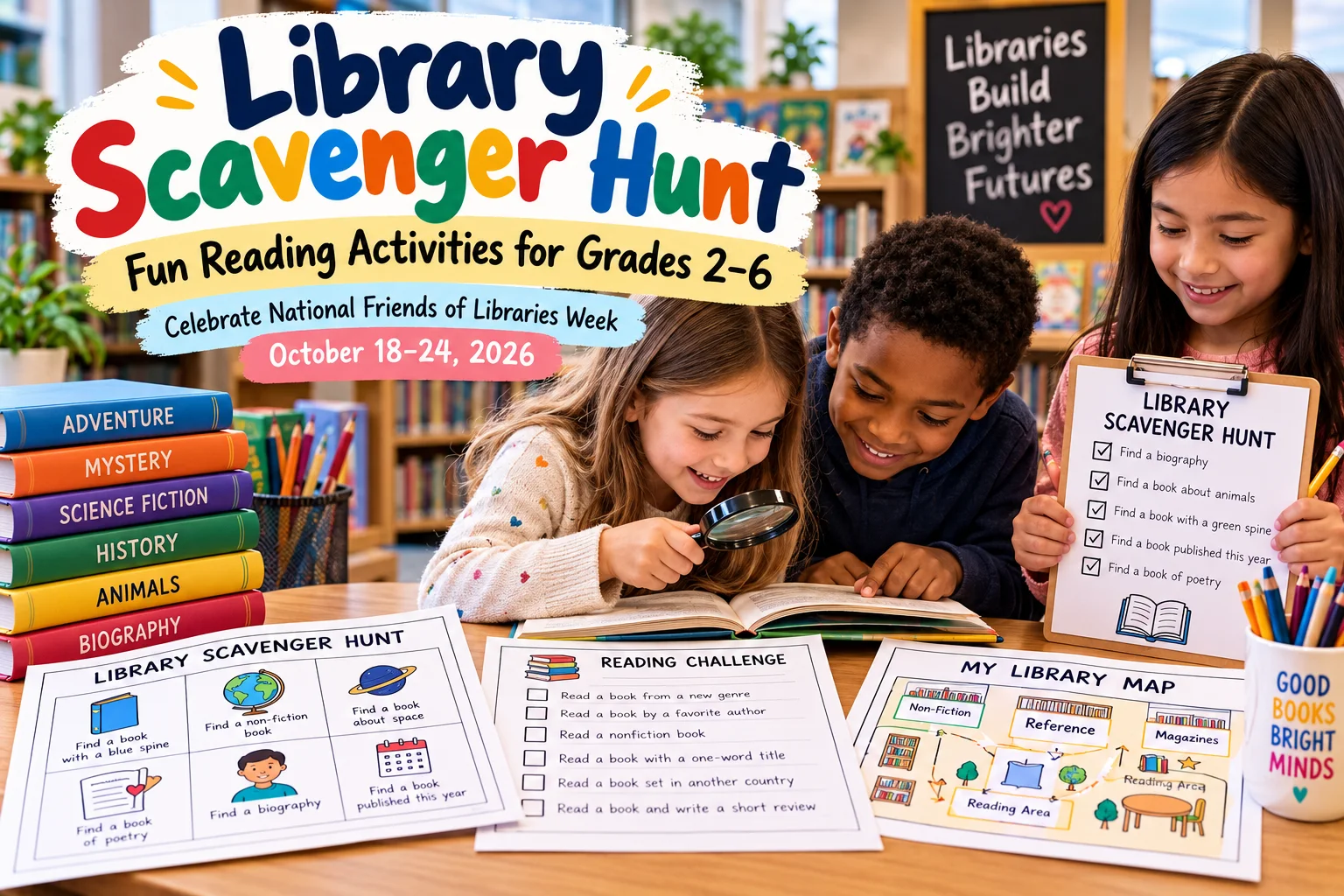
A library scavenger hunt sounds simple: hand students a page, let them search the shelves, and see what they find. With the right prompts, though, it can do much more than keep a class busy during a library visit.
Students can practice navigating shelves, identifying genres, using book features, making predictions, comparing texts, discovering authors, and choosing books independently. They can also begin to see the library as a shared community resource.
The timing is especially useful this week. The American Library Association's United for Libraries program marks National Friends of Libraries Week from October 18–24, 2026. For an elementary class, a useful starting question is:
What can we discover when we learn how to use a library well?
1. Find a Book You Would Normally Walk Past
Ask students to find one book they have seen before but never seriously considered reading. They inspect the cover, title, author, back cover, and first page, then answer: What made you ignore it before? What do you notice now? Would you read it?
This interrupts the habit of choosing only familiar series or familiar cover styles.
2. Hunt for Three Different Genres
Give students three targets: mystery, fantasy, biography, historical fiction, science fiction, poetry, informational nonfiction, or traditional tale. Students record one title for each and one clue that helped them decide.
The clue matters. Students should begin connecting genre labels with evidence inside a book.
3. Navigate by Shelf Location
If your library uses call numbers or another shelf system, give pairs a location rather than a title. Once they reach the section, they choose a book and record its title, author, shelf location, and one thing they learned about how the library is organized.
For younger students, simplify this to labeled sections such as animals, biographies, picture books, or graphic novels.
4. Find a Useful Nonfiction Feature
Ask students to locate a book containing a table of contents, index, glossary, caption, diagram, map, timeline, or bold vocabulary. Then ask: How would this feature help a reader?
That moves students from identifying text features to understanding why they exist.
5. Predict From the Cover—Then Revise
Students select a book from its front cover and complete: I think this book will be about ___ because ___. Then they read the back cover, flap, or first page and revise the prediction.
Ask what new information changed or strengthened their thinking.
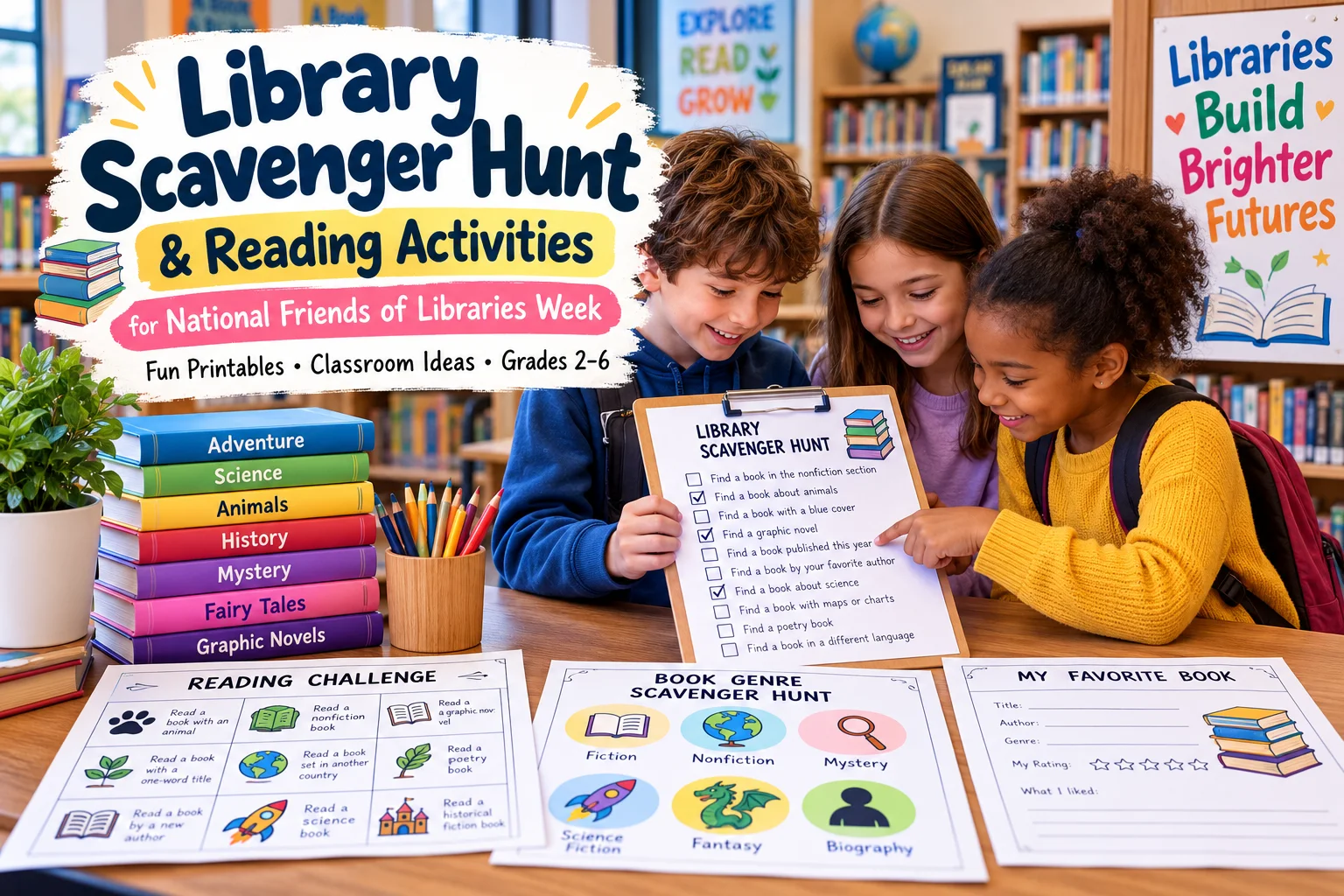
6. Compare Two Books on the Same Topic
Ask students to find two books about one topic—space, sharks, weather, insects, inventions—but intended for different readers.
FeatureBook ABook BAmount of text__________Pictures / diagrams__________Vocabulary difficulty__________Who might enjoy it?__________
Students discover that topic alone does not define a resource; audience and format matter too.
7. Create a Library Vocabulary Puzzle
Use words such as author, illustrator, genre, fiction, nonfiction, biography, catalog, index, glossary, borrow, return, and recommend. After students find the words, ask them to explain how five terms help someone use or discuss books.
The PosterCutter Word Search Maker can turn your own vocabulary into a student puzzle and answer key while you keep control of the instructional follow-up.
8. Recommend a Book to a Specific Reader
Give students a fictional reader profile: someone who loves animals but dislikes long books, a mystery fan, someone curious about how things work, a reader who likes funny stories, or someone wanting a challenging chapter book.
Students find one recommendation and explain the match. This teaches that a “good book” is not automatically the right book for every reader.
9. Do a Five-Minute Author Hunt
Choose an author represented in your library. Students find several titles, then compare covers, genres, series, illustration styles, and which title they would try first.
This helps students move from knowing individual books to recognizing authors and bodies of work.
10. Make a Library Helper Challenge
Ask: Your class wants to make the library easier and more welcoming for other students. What is one realistic thing you could do?
return books correctly;
create recommendation cards;
care for borrowed materials;
help make a themed display;
write thank-you notes to library staff or volunteers.
The goal is to notice how responsible users contribute to a shared resource.
11. Build a “Books We Discovered” Collaborative Poster
Give every student one tile of a large poster. Each student adds one book discovered, its genre or topic, and a six-to-ten-word recommendation. Assemble the pieces into one class reading display.
If you create the original design, PosterCutter's collaborative poster workflow can split it into ordered printable pages without manually cropping every tile.
12. End With a “Next Book” Ticket
Before leaving, students complete: One book I want to read next, I found it because, and What makes me curious. If students cannot borrow immediately, keep the tickets in a “Want to Read” pocket.
A scavenger hunt should lead toward reading, not end with the hunt itself.
A Ready-to-Use 30-Minute Library Visit
TimeActivity3 minExplain the hunt and model one prompt12 minComplete four challenges5 minPartner share: best discovery5 minChoose or record a next-read book5 minReturn materials / checkout / exit ticket
For younger students, use picture-supported cards and pairs. For older students, require evidence for genre choices and recommendations.
Turn It Into a Reusable Printable Kit
A flexible library kit could contain 12 challenge cards, a six-task recording sheet, a picture-supported version, genre reference card, nonfiction text-features checklist, recommendation slips, a “Want to Read” ticket, library vocabulary puzzle, and collaborative reading poster.
Individual cards are better than one crowded sheet because teachers can choose only the prompts that fit their collection.
For Teacher-Sellers: Solve the Library Visit
Library activities have a useful product advantage: they are not tied to one specific book. Current resources on TPT use scavenger hunts for navigation, genre exposure, book familiarity, and reading motivation. Eduki library-rally resources similarly use differentiated search cards and recording sheets, while Tes Resources includes library challenge and genre-hunt formats.
The stronger product angle is therefore not “cute library worksheet.” It is help the teacher run the visit.
State which grades the cards suit.
Explain whether students work alone or in pairs.
Say whether it works in classroom and school libraries.
Recommend how many cards to use per session.
Explain exactly what must be printed.
Describe how differentiated versions differ.
After the resource is finished, the PosterCutter Listing Generator can draft editable listing copy from accurate product details. Every claim should still be reviewed before publishing.
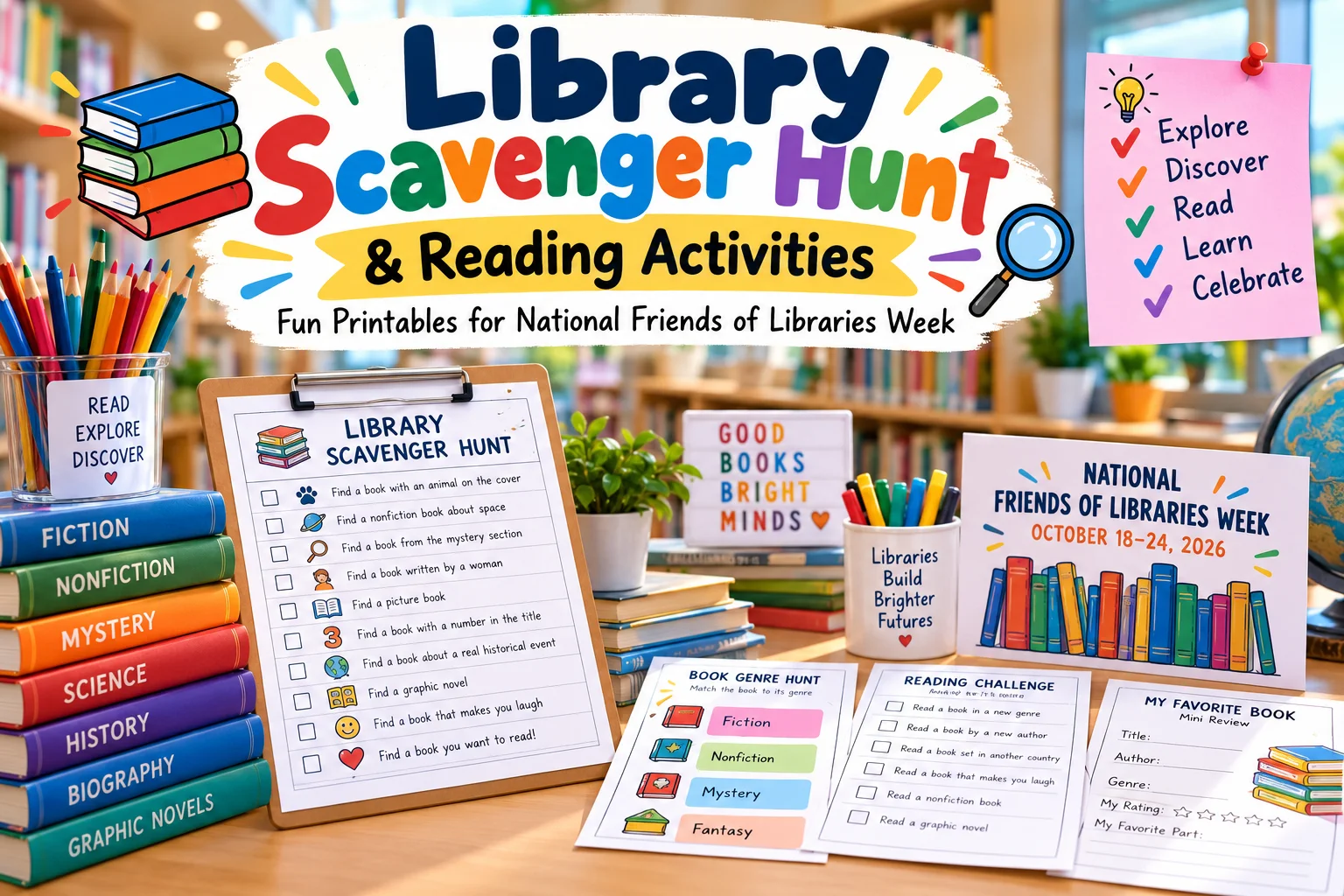
A Relevant PosterCutter Explore Option
The current PosterCutter Explore catalog includes the free Back To School Word Search Puzzle in its Reading category. It is not a library-skills lesson, but it can work as a quiet literacy warm-up, early-finisher page, or example of a simple puzzle format.
No other current Explore item is close enough to this topic to recommend without forcing the fit.
Keep the Hunt About Discovery, Not Speed
Do not reward the first student finished.
Let students skip prompts that do not fit the collection.
Do not pull dozens of books from shelves unnecessarily.
Follow the library's normal return procedure.
Build in time to actually inspect one or two discoveries.
The goal is not to “beat” the library. It is to become more confident using it.
Conclusion
National Friends of Libraries Week is a good reason to visit the library, but the strongest activity is one students can use after October 24.
Teach them to find a genre. Let them compare books. Ask them to notice text features. Give them a reader to recommend for. Help them leave with a real next-read choice.
That turns a scavenger hunt from a seasonal worksheet into a small lesson in reading independence.
If you are building your own version, create the library tasks first. Then use PosterCutter for repetitive production pieces such as a vocabulary puzzle or collaborative display while keeping reading decisions at the center.