 PosterCutter Blog
Character Counts Week 2026: 10 Classroom Activities That Go Beyond “Be Kind”
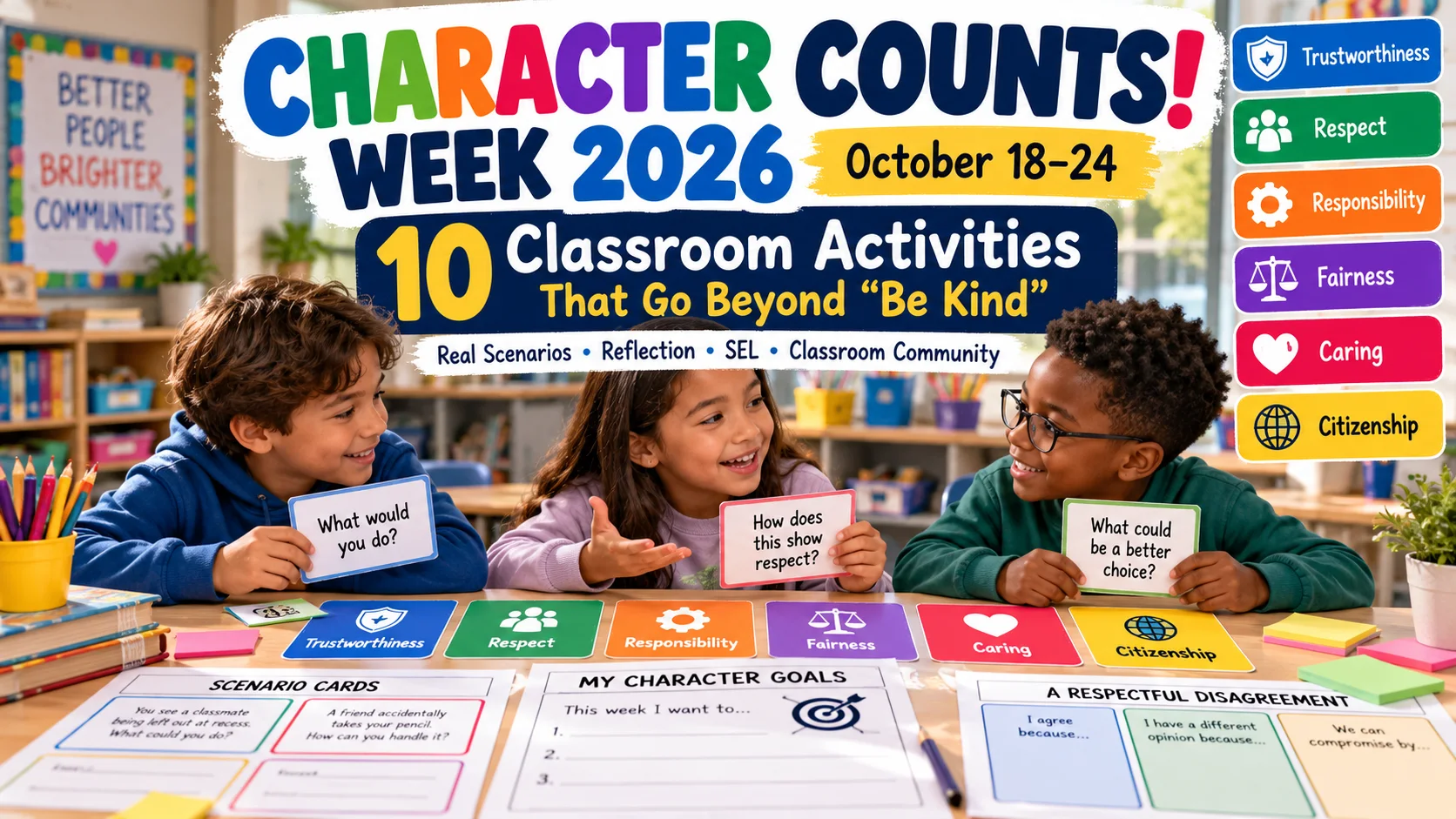
CHARACTER COUNTS! Week begins October 18, 2026. Instead of another generic kindness worksheet, use the week to help students practice trustworthiness, respect, responsibility, fairness, caring, and citizenship through real classroom situations. These 10 low-prep activities work especially well in grades 2–6.
“Be respectful.” “Make good choices.” “Be responsible.”
Students hear phrases like these all year. The problem is that knowing the word respect is not the same as knowing what respectful behavior looks like when a classmate interrupts you, somebody cuts in line, a friend wants you to hide the truth, or a group project feels unfair.
That is why CHARACTER COUNTS! Week, beginning October 18, is more useful when it moves beyond posters and definitions.
The official CHARACTER COUNTS! framework centers on six traits: trustworthiness, respect, responsibility, fairness, caring, and citizenship. The best classroom question is not “Can students memorize the six words?” It is:
Can students recognize what good character looks like when the choice is not completely obvious?
1. Start With “What Would You Do?” Scenario Cards
Put students in pairs or small groups and give each group a short situation:
You notice your friend looking at your answers during a quiz.
Someone new is standing alone during recess.
Your group gets credit for an idea another student suggested.
You accidentally damage a classroom supply and nobody saw you.
Two students both believe they should get the last available role in a project.
Ask: What choices could the person make? Which character trait is involved? What might happen after each choice? The last question pushes students past vocabulary and toward consequences.
2. Sort Actions, Not People
Create cards describing behaviors: returning something borrowed, admitting a mistake, listening while another person speaks, finishing a classroom job, giving everyone a fair turn, helping someone, or caring for a shared space.
Students sort the cards under the six traits. Some actions may fit more than one category, and students should defend their choices. Avoid labeling children themselves as “responsible” or “irresponsible.” Focus on choices and behaviors that can change.
3. Practice Respectful Disagreement
Respect becomes more useful when students practice disagreement. Give pairs a harmless prompt: recess should be longer; books are better than movies; homework should never be given on weekends; every class should have a pet.
Students practice sentence stems:
“I understand your point, but I think…”
“I see it differently because…”
“Can you explain why you think that?”
“One part I agree with is…”
Ask whether anyone understood the other position better even without changing their mind.
4. Make Responsibility Visible
Give students everyday situations and ask what happens after a responsible choice.
Situation Responsible action What happens next? You borrow classroom scissors. Return them correctly. The next person can find them. You forget part of an assignment. Tell the teacher and make a plan. You can fix the problem instead of hiding it. Your group has a shared job. Complete your part. The group can move forward.
Students see that responsibility often means making your part of a shared system work.
5. Ask Whether Equal Is Always Fair
Use scenarios that make students think: three students of different heights need to see over a fence; one student has an accommodation for additional test time; four students must divide project work after one was absent.
Do not reduce the discussion to one correct answer. Ask students to explain what fairness requires and listen to another interpretation.
6. Make Caring Observable
Instead of “be kind,” offer specific actions:
invite someone into an activity;
thank someone who helps the class;
notice when someone needs practical help;
give a sincere compliment about effort;
listen without interrupting;
help care for a shared space.
At the end of the day, students finish: Something caring I noticed today was… The goal is not points for kindness; it is learning to notice how actions affect a community.
7. Build a Character Vocabulary Puzzle—Then Use the Words
Use honesty, respect, responsibility, fairness, caring, citizenship, trust, choice, community, empathy, integrity, and cooperation. After students find the words, require a realistic example for four of them.
The PosterCutter Word Search Maker can turn your own vocabulary into a printable puzzle and answer key. Keep the reflection task attached so it remains a learning activity rather than filler.
8. Create a “Character in Action” Collaborative Poster
Start with one large black-and-white design divided into student pages. Each student adds an example to a prompt such as “Respect sounds like…,” “Responsibility means I can…,” or “Fairness sometimes requires…”.
Assemble the pages on Friday. The finished display contains student thinking rather than a teacher-created list of rules.
If you already have original artwork, the PosterCutter Printable Poster Maker can split it across classroom printer pages without manual cropping.
9. Write a Character Recommendation
Use: I would recognize ______ for showing ______ because ______. Require one specific example. “Maya is caring because she is nice” is vague; an example describing what Maya actually did connects the trait to evidence.
Do not make this a popularity vote. Assign names privately, recognize adults or fictional characters, or collect responses without announcing winners.
10. End With One Specific Character Goal
Ask each student to choose one behavior to practice next week. Replace “I will be more responsible” with “I will put my reading materials back before I leave.” Replace “I will be respectful” with “During group work, I will wait until the other person finishes speaking.”
Specific goals are easier to remember, practice, and reflect on.
A Ready-to-Use 5-Day Plan
Day Focus Quick activity Monday Trust worthiness + Responsibility Two scenario cards Tuesday Respect Respectful disagreement Wednesday Fairness Equal vs. fair discussion Thursday Caring + Citizenship Observable caring-actions challenge Friday Reflection Recommendation + personal goal
Build the collaborative poster one section at a time and assemble it Friday.
How to Make Character Printables Better
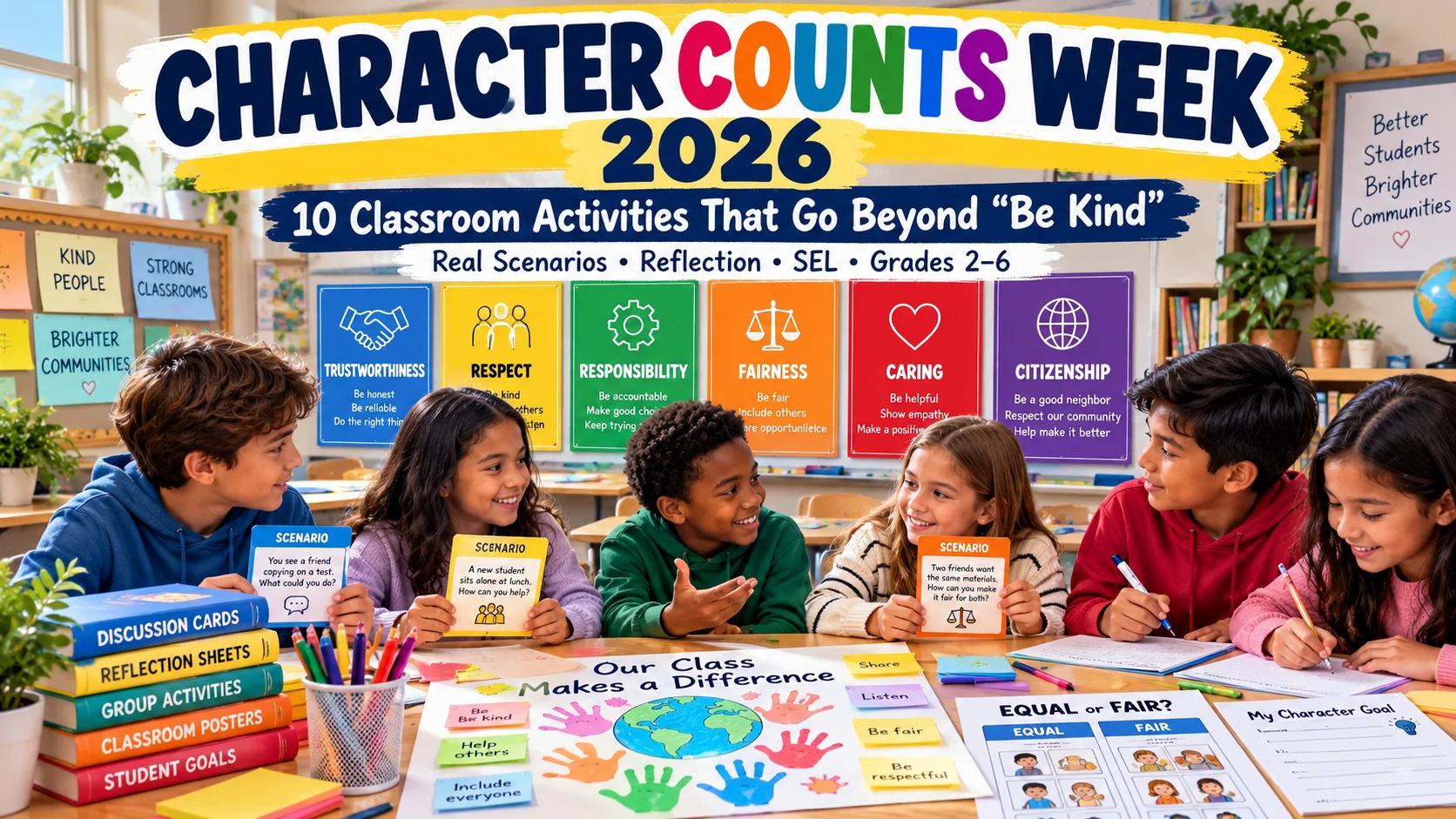
A heart border and “Write about respect” gives students little support. Stronger printables include a realistic scenario, choices to compare, a consequence to consider, evidence to explain, or a specific action to practice.
This matters for teacher-sellers too. Teachers browsing TPT, Eduki, or Tes Resources are looking for usable classroom formats. Scenario cards, discussion tasks, graphic organizers, and reflection pages give a character resource a clear teaching purpose.
A Better Teacher-Seller Product: Build a Character Toolkit
Instead of “Character Counts Week worksheets,” create a reusable system containing six trait mini-posters, scenario cards, action-sorting cards, a respectful-disagreement mat, fairness prompts, a vocabulary puzzle, recognition slips, a personal-goal sheet, a collaborative poster, and a one-page five-day teacher plan.
The October week creates a timely discovery hook, but the content remains useful during morning meetings, SEL, advisory, classroom-community refreshers, and conflict follow-ups all year.
If original artwork needs preparation for a larger display, the PosterCutter Printable Image Upscaler can help prepare suitable original or properly licensed artwork. You can also browse PosterCutter Explore for classroom-ready printable formats.
Keep Recognition Inclusive
Character awards can accidentally reward students who are already most visible. Look for quiet examples too: returning materials without being asked, admitting a mistake, including someone, following through on a small responsibility, listening carefully, or improving after feedback.
A student can make an irresponsible choice on Tuesday and a responsible one on Wednesday. Character is demonstrated through choices students can keep practicing.
Conclusion
CHARACTER COUNTS! Week does not need five days of slogans. Give students situations worth discussing. Let them disagree respectfully. Ask them to explain fairness. Help them notice caring actions. Connect recognition to evidence. Finish with one small behavior they can actually practice.
That is more useful than memorizing six definitions—and it gives you activities to bring back whenever your classroom needs a community reset.
If you are creating your own materials, build the scenarios and reflection first. Then use PosterCutter where it genuinely saves production time: creating vocabulary puzzles, preparing original artwork, or turning one class design into a large collaborative printable.